Outlook on Applied Art in Furnitureugo La Pietra
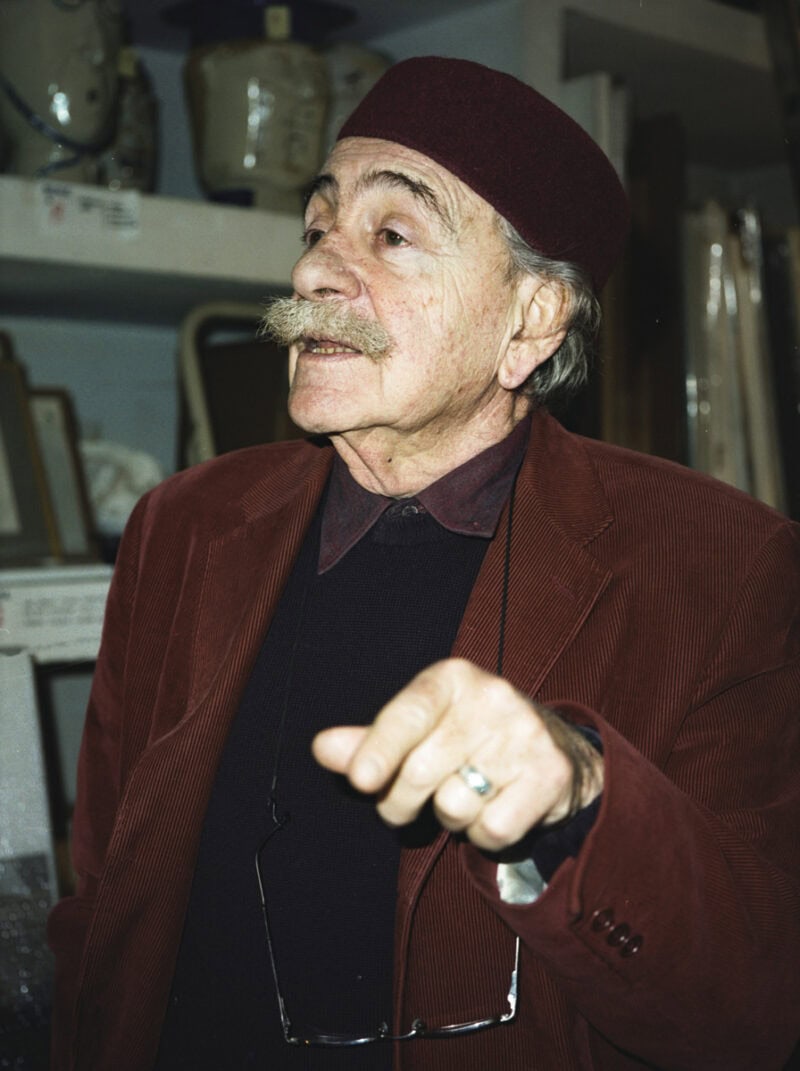
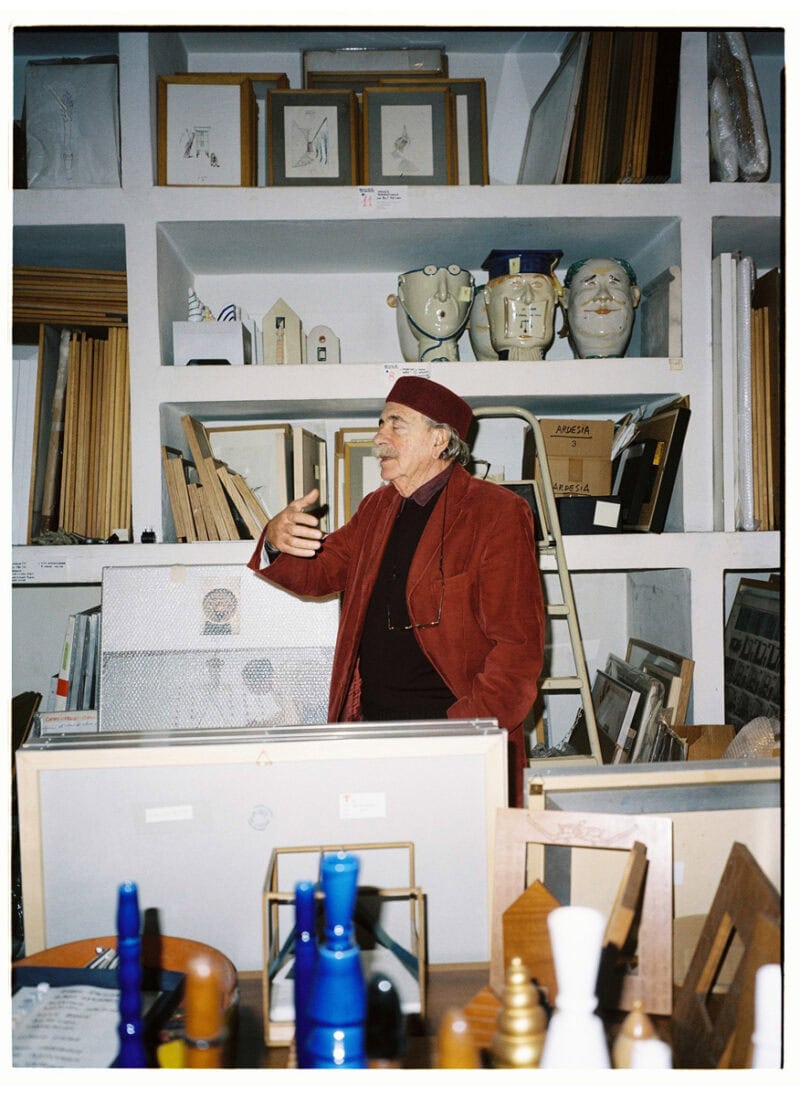
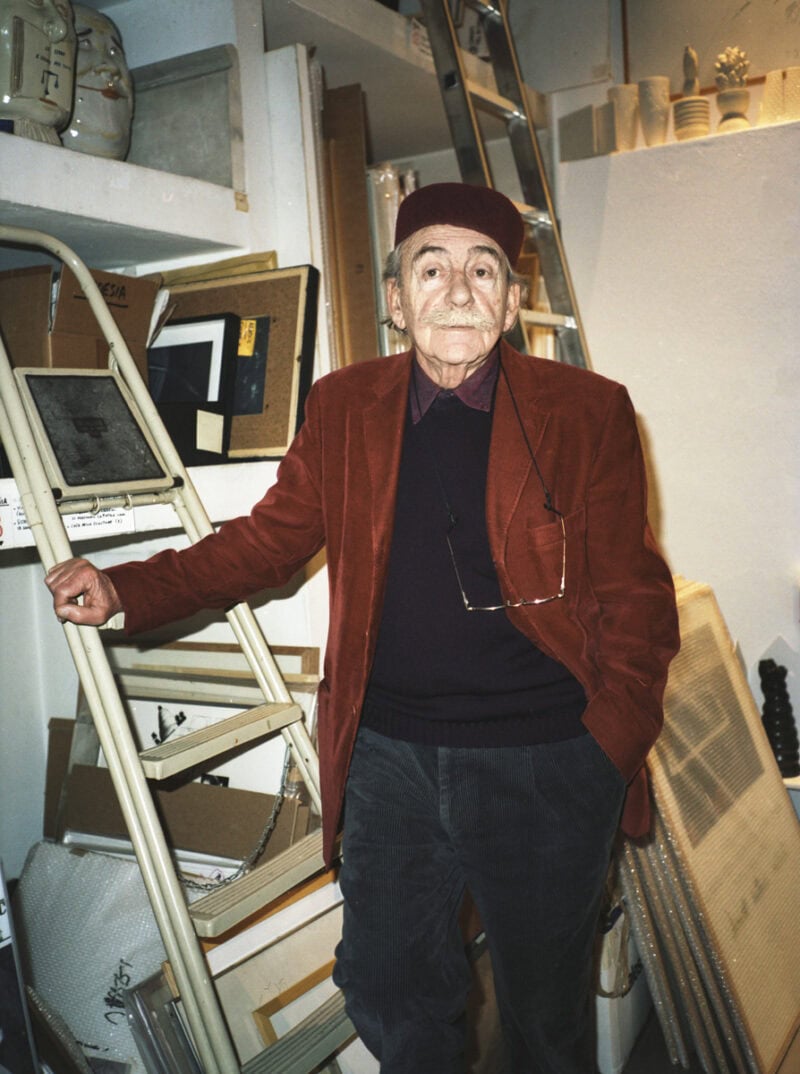
My gaze is immediately swept away whenever I enter Ugo La Pietra'due south studio. Every time that I descend those stairs, I see the Amore Mediterraneo ceramics and I wonder when they came nigh, just every bit I do with everything else that has invaded the studio layer by layer: books, ceramics, magazines, collages, piece of furniture and sculptures. The etymological meaning backside the Italian verb "to pattern" is simply "to throw forward". Ugo la Pietra has ever thrown frontwards for mankind and the feel and relationships that flesh enjoys in urban and public spaces. He does not build spaces, rather he designs places and creates imagery from daily life. He dreams by drawing, sees by photographing and walks past counting. But more than than anything else, he has defined an approach that always prioritises life over the project itself. Ugo la Pietra reflects on the futurity past living in the nowadays. Many people would phone call him a pioneer; I hope this interview will bear witness that he is a genius.
Which elements within the urban space are primal for a city to feel welcoming?
For many years I have theorised that a city, in order to become such, must accomplish what is called the "urban event". The urban effect stems from a series of different elements that range from traffic to civilization, from information to moments of decompression (such as entertainment and leisure). When all these elements are present, you take a city. Cities can very frequently be homogeneous (in Japan, for case), configured every bit big monocultural settlements that only sell electronic equipment, for example, or where the local economic system is entirely based on amusement. When the situation is this heavily restricted to a unmarried category and areas are heavily monopolised by a unmarried component, the location cannot still be called a metropolis – as is the example in Milan's Chinatown, where all the shops are wholesale and there is nothing else on offering. Yet, when all elements are present and co-participate, this creates the so-called urban event and we tin say that nosotros are looking at a city. Of grade, for a city to part, all these elements must exist correctly proportioned, and then that no chemical element is in whatever way curtained, hidden, or even eliminated. For case, if a city's urban effect is over-proportionally achieved by traffic or commerce but the fundamental components of decompression are missing (i.e. places with lower levels of crowding and noise), then we have a trouble.
The underlying principles are the same as any natural miracle. In a wood, for example, many elements coexist. These include copse and bushes, of form, but equally grass and flowers. These components are all part of a unmarried overall phenomenon. This overall phenomenon is fabricated up of many elements which must exist in harmony. That is why many authors – especially artists – adopt disquisitional attitudes towards the urban. Ane of the things revealed in their work is the exaggerated presence of the commercial system at the expense of culture. Or possibly the exaggerated presence of traffic and a complete lack of information. All these components should exist present yet ofttimes this is not the case. Why not?
Permit's imagine that I am a ninety-year-onetime woman and I want to become from my home to Ugo, meaning I have to traverse the public space…
Poor woman…
…which elements should I wait to come across on my journey?
Well, in order to survive – which doesn't necessarily mean being happy…
Is survival different to living?
Of course. Living is a standard far to a higher place survival and information technology means achieving results, such every bit living somewhere that represents us, a place that we accept modified in some style. Your personality dilates in your own home while this is non the instance in a hotel room.
Mere survival, i.e. good utilise of space (which is different from liveability) requires at least iii fundamentals: access to water, the means to go to the toilet and the ways to residual. If an private is unable to perform these three actions, they will have serious survival issues.
And this does not apply solely to the elderly; even the young will dehydrate in 10 hours. Yet the city more often than not ignores these basic elements. For example, in the eye of Milan, an avant-garde city in many respects, the rear of Palazzo Arengario is regularly used as a toilet. Any tourists caught brusk in the city centre will use a corner to save themselves. And this has been going on for decades. There has never been any attempt to forbid this kind of behaviour, permit alone find a solution to the trouble itself. Information technology is an ancient problem that remains unresolved since the local administration doesn't take this type of problem into consideration.
In The Reappropriation of the City, produced past the Centre Pompidou in 1977, you lot claim that it is easier to identify traces of creative behaviour that modify the territory in the city suburbs, where the system is weaker and less efficient. Exercise you all the same believe that this is the case?
A little less and so and a niggling more so. In the 1960s, the suburbs were more or less abandoned, in the true sense of the word, just far from marginal in terms of size.
Gordon Matta-Clark, who studied them closely in those years, perceived them differently, seeking pocket-sized fragments of unused territory – the same fragments that were set upon with a sure chapters for invention and transformation by the locals. There were those who created urban gardens, or other types of temporary and abusive structure. Nobody ever purchased these spaces between the railway and a thruway, information technology was rather a form of conquest. Consequently, these territories were much more flamboyant then than they are now. They stimulated people who wanted to use manual skills and to create and transform a space.
Today the question of the suburbs is a little different, in the sense that there is indeed the want and need for transformation, just within a more social dimension – the relationship between the environment and the groups that accept formed there. The discussion becomes more circuitous, about sociological, and not but anthropological.
To summarise, in the 1960s, there was this desire to conquer a space and build something, today it is quite different. Today, people wish to brand these suburbs into habitable places, that is, suitable for activities, with a purely social pattern intent.
I would add something banal: a communal garden is the development of the private garden, a infinite that pensioners could conquer and visit in their spare time. It meant in that location was a transformation taking place, increased sensation, maybe even a more powerful response from the territory to a common and securely felt trouble. Let me explain better: today the suburbs are non just the scraps of the city but real spaces, with a concrete size and vital strength that is i hundred times more important than that of the historical eye. They take expanded. They are no longer marginal but a remarkable presence, both physical and social, and therefore likewise in terms of vitality.
In this regard, there is necessarily a difference between yesterday and today.
Temporary structures take always attracted you. The work you did on the embankment in Cagliari comes to mind…
Of course, the Poetto houses.
Why is that?
This is a little besides personal, I recollect.
Well, I take always been fascinated by smaller architectural structures. Poor and modest structures made with very trivial. This might stem from my formative years, when I lived in my granddaddy's house for a long fourth dimension – it was a poor dwelling, it didn't fifty-fifty accept running water. We lived on a much smaller scale than nosotros do in our homes today simply, for that very reason, what we did take was highly valued.
This has zero to practise with information technology, only since yous asked… When I was 7 years old, I took an old chicken coop and fabricated information technology into my home: information technology was pocket-size and humble (as I said, it was a chicken coop). In short, this is a personal passion that is closely tied to my childhood and my development.
But spontaneous architecture – and this is the real answer to your question, forget that stuff about my childhood – has always interested me more than so-called cultured architecture. This is because I have always found in spontaneous architecture the values that cultured compages cannot offering. The same values I find in rural architecture, which was the subject field of much of my research in the 1960s. The rural architecture of lower Lombardy, of Salento – stone structures, to exist clear – and so Poetto, etc. This is where I found the manual component that we radical 1960s architects were looking for: the practise-it-yourself approach where the individual builds their own house with their own hands, tools, and structures. This is inevitably the utmost expression of inventiveness because everyone does it in their own way. This is what I was looking for with my inquiry and am however looking for today. I am still just as attracted to and intrigued by spontaneous architecture as I have always been. At the 1978-79 Venice Biennale, I was able to utilise all the tools that I had "stolen" from rural environments. I say stolen, I obviously left some money. I went to these houses, these urban gardens, and when the owner wasn't there (they weren't always there, they often had other jobs), I left 5,000 – 10,000 lire and took the tools they had made for themselves. They were all tools fabricated with recycled materials; they were incredibly interesting, and I managed to create an exhibition with them.
You have already answered in part what I wanted to talk about next but my bespeak ends with a specific question so I will read it all anyway. In The Reappropriation of the Urban center, you lot also explore how crucial information technology is to recover transmission and creative activities if we are to awaken the faculties atrophied by the working society. I find this to exist a highly gimmicky thought, specially since yous developed it as part of a process linked to the reuse and recycling of abandoned objects. What is creativity for you?
Well, much was written about inventiveness in those years. For me, creativity has ever been a category to spread as far and wide as possible. My opinion – which remains unchanged today – was that if somebody wants to brand music, they don't necessarily have to do x years at the solarium. They can selection upwards a guitar and play it. And that applies to everything. It means giving society the opportunity to be creative without going through the so-called categories or the various institutions that issue "creative licenses". Take the builder, the interior designer, the artist, the visual merchandiser… In that location are so many different categories that define creativity and pigeonhole it into a very precise definition. Social club is more and more organised, and it increasingly wants to identify you somewhere specific. Creativity, however, disregards these positions, and that is why I also practice this manner of life on a personal level. For example, I love music, so I started playing; I have played in an orchestra my entire life without knowing a unmarried annotation. That is quite unusual. Apart from the fact that I have played aslope some extraordinarily talented people, all I did was rely on an innate characteristic, that of having a good "ear". The same applies to painting. I have always painted without always having studied it. I am certainly no Academy of Fine Arts graduate, simply I even so paint regularly, every twenty-four hour period.
Sadly, our society does not share these ideas. Instead, creativity is linked to categories and to models, and therefore to extremely specific constraints.
In both Preferential Itineraries and We are looking for the class built-in out of our experiences instead of imposed schemes, y'all place the private in the centre. Non architecture, not houses but the private. As though the city were made up of the people who inhabit it and not the streets and buildings that course it. Do you recall that this arroyo is purely mental, or should it exist physical? By which I mean, does this attitude besides utilize to artistic discourse? I gave the example of the Preferential Itineraries, but y'all have tackled information technology in much of your work.
Yeah, it definitely likewise applies to creative discourse. Precisely because I know architecture then well, both as a student and a scholar (although never having built anything), I have always known that cities are made of individuals. In a country like Italian republic, where urban centres mainly consist of consolidated architecture that endures and is repeated for centuries, it is easy to reach the conclusion that it is people who make cities, non houses. The houses might be 100, 500, 1,000 or fifty-fifty 2,000 years old… It is therefore obvious that they cannot be truly representative of a place and a society at any given moment.
But what does it mean to identify people at the centre today? This is an abstract procedure within the urban center. You lot were saying nearly creativity…
Placing people at the eye is something that derives from a adequately classic definition for me: a city made of people rather than houses. In this sense, the individual becomes a central element in the recognition of urban movements and the meanings of things; it all passes through people and their behaviour. This is an ancient lesson.
I always think of Munari every bit an case. He went to Japan (nobody used to go there at the fourth dimension) and returned with a passion for Japanese culture. He came back and said, "Exercise you know that one-half of the world'due south population lives without a bed?". He would say this to designers, to make them understand that design should never start from typology, every bit they had been taught in universities. "Today nosotros are going to design a chair…". No, design should always start from the behaviour of the individual. For example: "What can be done to respond to the private's need to sleep and balance?". Well, half the world uses a mat, which they place on the footing and sleep on. Design must always showtime from the individual, from their behaviour and their rituals, also as their changing needs. Information technology is from these fundamentals that a creative-blueprint response tin can be developed.
But this very rarely happens. Instead, design almost ever starts from consolidated categories, which might take been outdated for some fourth dimension without anybody realising. When I did the Telematic Business firm in 1983, I showed how the domestic ritual of sitting around a table for tea was now outdated, interrupted by the presence of the television, which had completely changed the hierarchy of things. Merely still designers continued to design central tables, with armchairs positioned effectually them, imitating a ritual that had long been lost. Nobody saw what was really happening within people's homes, where they sat in front of the TV as though they were in a small movie house.
This might be why I became quite famous in the earth of design. Not and then much because I designed something. Naught I designed has really ever gone into product. But I always idea it was important to make certain things understood, things that the discipline unfortunately oftentimes ignores. Because like all disciplines, it starts from the disciplinary categories, instead of the individual.
The fusion of disciplines, the breaking down of walls, the periphery, public space, private infinite, the politics of perspective, interactive and relational works… You lot take pretty much done it all. You are a bully designer and you are interested in urban planning, pattern, and painting… So, who is your inspiration? Who is your office model in the history of fine art?
I'm going to tell you something that might make yous laugh. People encounter me writing two, three, iv books a yr and they ask, "Why are y'all writing all these books?" And I answer, "Leonardo created six or 7 works in his life, hardly annihilation. But he wrote pages and pages describing everything he did, thought and hypothesised…" Information technology'due south not that I want to compare myself to Leonardo, but I promise that my identity might be considered similar to his, at least by analogy. Particularly since I've built practically nothing, as an artist I've been asked to exercise iii or four urban projects. When I give lectures, people ask what I would yet like to attain at present that I am over 80 and I always reply cheekily that I would like the Municipality of Milan to dedicate a flower bed to me. That hasn't transpired equally notwithstanding! But they didn't even dedicate one to Munari, or Sottsass… These not bad artists passed through Milan and left not even the slightest trace.
In brusque, I wouldn't mind being compared to Leonardo, he just did a few things, but he wrote a lot.
Then at some indicate in my life I discovered another figure who I won't say is similar to me only who I feel a certain affinity with, and that is Ponti. He was so at ease in moving from ane category to some other and overcoming disciplinary models. He did design too just was "sentenced to death" for having created a lot of decorative design with Fornasetti in the 1950s and 1960s, at a time when Italian design was very clean and minimal.
In short, Ponti, who I have studied extensively and as well written a book nigh, is somebody that I have always liked because of the relationship he had with the practical arts, and considering of his passion and his desire to be an artist. In reality, he e'er wanted to be a painter and the fact that he wasn't caused him keen suffering. His most important biographer, Agnoldomenico Pica, wrote that "Ponti always cried considering his function model was Campigli; he wanted to be an artist-painter".
Somebody else that I really like and consider a office model is the architect Vittoriano Viganò. He too had always wanted to exist an artist and he merely frequented other artists – Milani, Crippa, Dova – during his time in Milan, never architects. Similar many others, he was an architect only always felt that he was, above all, an artist. I am too haunted by this. Anyone who lives their life intensely will be faced with obstacles. Take Sottsass, who was banned from building houses. He was a designer, but he wanted to be an builder. Information technology's non that I suffer from not having built or fabricated annihilation: my suffering is more related to a certain relationship with the outside world, therefore the city, and the few projects that I accept had occasion to work on.
I am currently writing a volume and organising an exhibition that will be held before long in Spoleto, where I will bring together the few but significant pieces that I have created for the urban environs during my life.
Don't worry, this outcome is defended to the New Renaissance, and then…
Yes, I would say it fits.
Something else I wanted to ask is whether yous see whatever human relationship betwixt your research into monumentalism and the Star Organisation?
Well, I have ever criticised monumental architecture every bit an undemocratic expression of an intention. Merely equally anybody who is familiar with my work will know, from the early 1960s I designed many architectural structures that I called "urban nodes". They were almost all bought by the Pompidou. They were quite item designs, but the point was what they represented: they were meaningful elements inserted into an anonymous and repetitive urban fabric.
Consider, for example, the suburbs of Tokyo: miles and miles of identical, homogenous housing. I idea it was correct to create something meaningful within that setting, something that would provide orientation as an "important object".
Today'southward so-chosen archistars enhance a like discourse yet create "significant objects" in urban contexts that have no need for them, places that practise not demand an exception to interrupt the anonymity, or repetitiveness. Places such as Bilbao, Turin, Milan… Places with consolidated and historical urban configurations.
Permit's take Milan. Milan is a horizontal city that has no need for vertical interventions. It is alike to dismissing h2o every bit a founding element of a urban center built on h2o. Whether that is the bounding main, a river, or a culvert. These are cities that already have their own intrinsic meaningful elements, making the introduction of an external "important object" improper. And this is where "monumentality" comes into information technology, in the sense that the characterising object is inserted into a dimension that doesn't need information technology, when these elements could represent a solution or a style to requite value/pregnant to the homogeneous and bearding situations institute in many other urban spaces – the suburbs, for instance.
And then, sometimes, when I look at my drawings from the early 1960s, I realise that I was doing like things but that they were destined for another dimension on another scale and certainly represented a different option both in terms of culture and design.
There is no doubt about that.
So, what is the identity of a territory?
The identity of the territory is a concept that will feature in the book I am writing and that I raised several times in the course I taught at the Polytechnic and the Academy. I explain that when you lot arbitrate in a space – whether as an artist, architect, or designer – for me, the design must stem from analysis of the territory and its resource.
The territory will always tell you something. Sometimes it is striking: if you go to Ostuni, for example, where all the houses are white; you don't pattern a ruddy house. Simply the resources can often be something much deeper: behaviour, history, stratification. Each territory therefore necessarily has its own identity.
Here in Italy, we have an advantage. Each square centimetre has its ain pregnant, a stratified value: there is no village that cannot say "this was formerly a Roman settlement, and the Etruscans were here earlier that…" This is history but also identity.
The project that I asked the students to develop would ever be tied to the territory. I often chose particularly challenging realities, peradventure a route with nothing on information technology. Or perhaps at that place were iii greengrocers there and they were the resource around which to develop the projection, because they formed identity of that route. Information technology is easy to go to Salento and notice that Lecce stone is the foundation of the architecture, from the menhir to the Baroque. It is piece of cake to spot concrete and material resources, merely I like to focus on deeper layers.
Designing for territoriality therefore means engaging with a specific context and being aware of its existing identity, at least in part. In a place like Italy, diversity is excellence: it is the near common expression of the essence of a place. Every village has its own way of making cappelletti (and name for them!), just as people from different areas accept their own specific physiognomies. Diversity should therefore be the starting point, especially in a time similar this. I was already making this point in the 1970s and 1980s, when globalisation was just taking hold. Simply what does globalisation mean? It means that either you play the game, just lose who yous are, or y'all celebrate your differences, which is the opposite of globalisation. And that is how certain legends are born, such every bit the excellence of our wines. Why? Because we succeeded in giving them a strong identity.
You take always worked with local craftsmen, whenever y'all were invited to work anywhere.
This is precisely the meaning of territoriality and, therefore, blueprint linked to genius loci, the identity of a place. It is something that should be cultivated, especially in Italy, where these values are easily recognisable. This is not the instance in France, where yous tin travel for miles and miles through very homogeneous and repetitive territories and it is much harder to identify certain characteristics.
You lot will know that collectives accept been making a comeback for some years now. And you have enough of experience with collectives since you have been backside a number of them, starting with Global Tools. I was wondering who you worked all-time with and what differences you observe betwixt the collectives from those years and those of today, in terms of blueprint. I know you have besides collaborated with some young people, so you should take a yardstick…
I am ever open to collaborations and working with others. But the collectives that I was a central figure in were always born from item political and social situations. Because it can be difficult to come up together, specially in a city like Milan, which is chaotic and has much to offer. Information technology was only really possible in moments that were historically weak for society – the energy crises of the 1970s, times when there was a lack of work, a lack of opportunity… These were all factors that brought groups of people together. Turin's poveristi grew out of a city that offered absolutely nothing, just as the radicals of Florence sought a way out of a city that revolved solely around tourism and provided no opportunities. It was the early on 1970s when we started Global Tools, the Cooperativa Maroncelli and the Fabbrica di Comunicazione in Milan: a very hard time, where galleries no longer had a role to play, in that location was no market, the free energy crisis was happening… It was a complex situation. After that, when Milan started operation once again, with the boom of the 1980s then this 3rd (smaller) boom, this type of collaboration decreased significantly.
Lately collectives accept increased again precisely because the crunch has returned. The marketplace has completely excluded architects and designers, who, for example have ventured into self-production… There are no opportunities for them, for sales or commerce or anything. That is why they have started to come up together once more and to collaborate. As a collective response to a crisis.
That is true but permit'south have the magazine "Inpiù" equally an instance: there was a projection, a indicate of view, and a vision of the city backside it, with a different perspective offered by each collaborator. It was a story that was pattern-orientated, while today…
Considering these magazines were similar exhibitions. They would call ten, thirty or fifty people to answer with an ad hoc piece (not their usual piece of work) around a specific theme. There was a detail method backside information technology, in view of the occasion. Information technology is a bit like the Campo Urbano outcome in Como, which I always mention. It was the merely major interesting exhibition. Not because information technology was ephemeral (although that did help), non because it was earlier the keen attacks – the Piazza Fontana bombing happened immediately afterwards only until so we were however euphoric and optimistic – simply for another reason: the artists that participated did not bring their standard piece of work. When yous look at the catalogue, anybody created pieces especially for the occasion, pieces that did not necessarily resemble their usual work. Then, it was a highly creative operation based around a theme, which is what I did whenever I organised an exhibition or fix a magazine. There was a theme that the authors had to somehow attach to and play their part in and so that it wasn't a simple collection, but a set of works put together co-ordinate to a certain logic. It is not easy to propose this model today, considering the Art Director – who is responsible for collecting all the material for an exhibition or publication – is neither an artist nor a creative but usually a curator or historian, no doubt very well informed but lacking direct experience. When I organised exhibitions, I made certain that the exhibition pattern itself was a work of art. Today, the exhibition designer simply seeks to adjust the artworks then that they are visible, nothing more than. When I adult the exhibition design for the Cronografie exhibition at the Venice Biennial, I get-go imagined a serial of structures and boxes that expressed memory and then that the setting – before even the work – responded to the theme in question, through an almost physical, certainly figurative gene.
That is what makes the difference. I complain a lot nowadays near non beingness able to work the way I used to. In the past twenty years, I have only put on my own exhibitions. Information technology is rewarding, of course, but I no longer do things with others or for others. I no longer accept that opportunity and I really miss it. I envy people similar y'all who succeed in doing things, bringing people together and building events, which has always been a part of my true nature.
In Spazio Reale Spazio Virtuale, a film made for the XVI Triennial ('79), you tackle the art organisation: artists, curators, directors… everything that an art event entails. Practice y'all find that the organisation has changed today or not?
Not at all! This is exactly what I've been complaining about of late. The last Triennial was the terminal coup de grace to what used to exist an important and positive tradition, because it used to exist like to what nosotros were discussing before: it had a theme so, with a coordinator at the reins, it gave a number of creatives the opportunity to create work. To make something advertizing hoc. Every bit far back as Fontana, everyone knows that the Triennial has always been a place of great experimentation. Where dissimilar artists – architects, designers, painters, etc. – were able to create work. Not reproductions of the work in their studios, just elaborations on a theme. Information technology was an opportunity to do something new, whether that was an object, an surround, or a collection.
This has been completely lost. The concluding Triennial, for example, had an fantabulous and very current theme only the result was alike to a typical Expo exhibition, where the public is given information nearly things that might happen, things that volition happen, bug, innovation, engineering… Information technology was purely didactic, no doubt intelligent and interesting, but non creative. Society is given an thought, an image of what might be the solution to a theme, in the past, present, and future. Some other great thing about the Triennial used to be that all the craftsmen, companies and production facilities competed to finance and implement the different projects, which provided a wide range of opportunities for participants. For example, if you went to a visitor that produced neons and told them you had to create a slice using neons, they would fund the work. At that place was a mechanism of complicity and exchange that has been lost over fourth dimension and certainly no longer exists today.
The Triennial therefore lost that identity every bit a catalyst for opportunities and Boeri, who is certainly an intelligent, capable, and political person, missed something there. He did non understand that this would outcome in the Triennial losing the primacy it had ever had, as a place of encounters and challenges, as well as a stimulus for the production of cute, important, creative, and inventive things. Looking back on the Triennials of the 1950s and 1960s, it is clear that that identity has been lost for some time, but this last intervention has not improved matters. Information technology was an loonshit of development and at present that loonshit is no more. In that sense, there is no further progress compared to the past. It did attract 8,000 visitors in 10 days though… That is true…
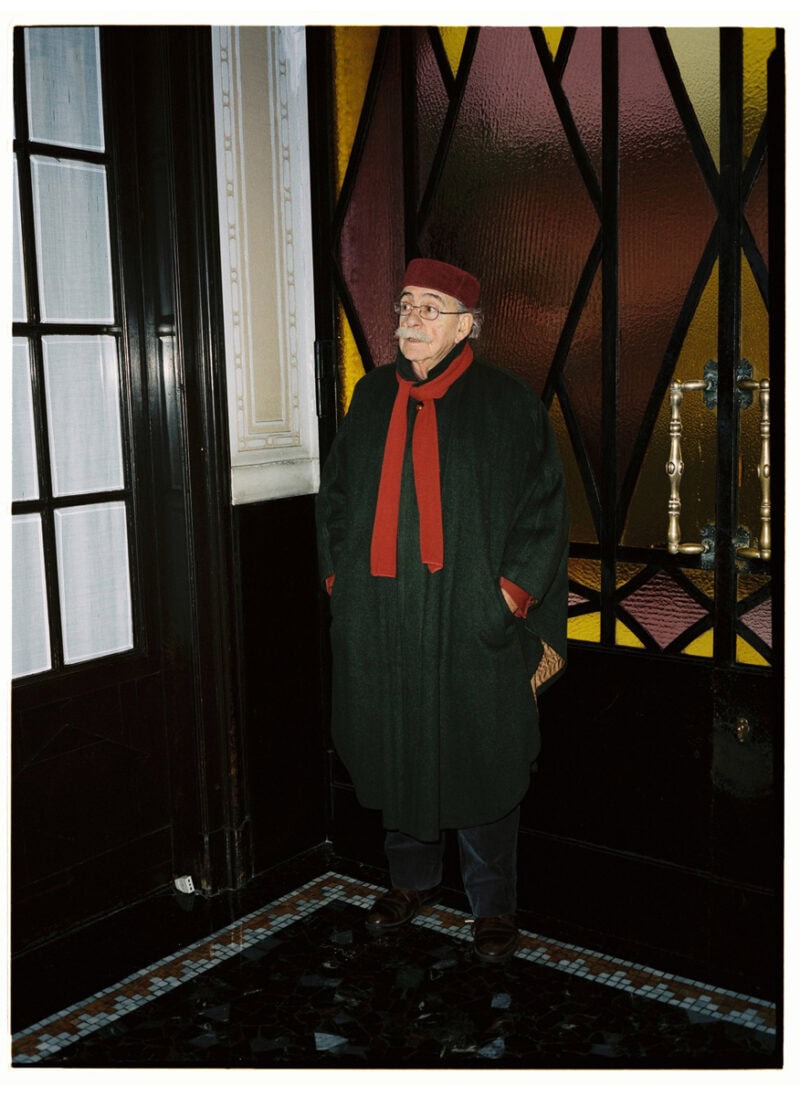
Credits:
Words by Rossana Ciocca
Photography by Leone
Starring Ugo La Pietra
guerrieromusbacked.blogspot.com
Source: https://www.c41magazine.com/inside-issue-10-ugo-la-pietra-c41-magazine/
0 Response to "Outlook on Applied Art in Furnitureugo La Pietra"
Post a Comment