Korean Art During the Three Kingdoms Period Is Known for
| Three Kingdoms of Korea | |
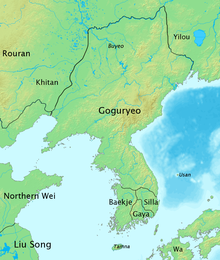 Map of the Three Kingdoms of Korea—Goguryeo, Baekje, and Silla—in the fifth century, at the height of Goguryeo's territorial expansion | |
| Korean name | |
|---|---|
| Hunminjeongeum | 삼국시대 |
| Hanja | 三國時代 |
| Revised Romanization | Samguk-sidae |
| McCune–Reischauer | Samguk-sidae |
| Other proper name | |
| Hunminjeongeum | 삼국시기 |
| Hanja | 三國時期 |
| Revised Romanization | Samguk-sigi |
| McCune–Reischauer | Samguk-sigi |
Samhan or the Iii Kingdoms of Korea (Korean: 삼국시대 ; Hanja: 三國時代 ; RR: Samguk-sidae ) refers to the iii kingdoms of Goguryeo (고구려, 高句麗), Baekje (백제, 百濟), and Silla (신라, 新羅).[i] Goguryeo was subsequently known as Goryeo (고려, 高麗), from which the modern proper name Korea is derived. The Iii Kingdoms menses is divers equally being from 57 BC to 668 AD (but at that place existed most 79 tribal states in the southern region of the Korean Peninsula and relatively big states like Okjeo, Buyeo, and Dongye in its northern part and Manchuria of modern Cathay).
The three kingdoms occupied the entire peninsula of Korea and roughly half of Manchuria, located by and large in present-day China, forth with smaller parts from nowadays-day Russia.[2] The kingdoms of Baekje and Silla dominated the southern half of the Korean Peninsula and Tamna (Jeju Island), whereas Goguryeo controlled the Liaodong Peninsula, Manchuria and the northern half of the Korean Peninsula. Baekje and Goguryeo shared founding myths which likely originated from Buyeo.[3] Buddhism, which arrived in Korea in 3rd century CE from Republic of india via Tibet and China, became the state religion of all 3 constituents of the Iii Kingdoms, starting with Gaya in 372 CE.[4]
In the seventh century, centrolineal with Mainland china under the Tang dynasty, Silla unified the Korean Peninsula for the commencement time in Korean history, allowing for the first united Korean national identity. Afterwards the fall of Baekje and Goguryeo, the Tang dynasty established a short-lived war machine government to administer parts of the Korean Peninsula. Even so, every bit a outcome of the Silla–Tang State of war (≈670–676 AD), Silla forces expelled the Protectorate armies from the peninsula in 676 AD. The following flow is known as the Unified Silla or Later Silla (668–935 AD).
Later, Get of Balhae, a quondam Goguryeo full general[5] or chief of Sumo Mohe,[6] [7] founded Balhae in the former territory of Goguryeo after defeating the Tang dynasty at the Boxing of Tianmenling.
The predecessor period, before the development of the full-fledged kingdoms, is sometimes called Proto–Three Kingdoms period.
Main primary sources for this period include Samguk sagi and Samguk yusa in Korea, and the "Eastern Barbarians" department (東夷傳) from the Book of Wei (魏書) of the Records of the Three Kingdoms in China.
Classification [edit]
Beginning in the 7th century, the name of polo g[8] "Samhan" became synonymous with the Three Kingdoms of Korea. The "Han" in the names of the Korean Empire, Daehan Jeguk, and the Democracy of Korea (Due south Korea), Daehan Minguk or Hanguk, are named in reference to the Three Kingdoms of Korea, non the ancient confederacies in the southern Korean Peninsula.[ix] [10]
According to the Samguk sagi and Samguk yusa, Silla implemented a national policy, "Samhan Unification" ( 삼한일통 ; 三韓一統 ), to integrate Baekje and Goguryeo refugees. In 1982, a memorial stone dating back to 686 was discovered in Cheongju with an inscription: "The Iii Han were unified and the domain was expanded."[9] During the Later Silla menstruum, the concepts of Samhan every bit the aboriginal confederacies and the Iii Kingdoms of Korea were merged.[9] In a letter to an imperial tutor of the Tang dynasty, Choe Chiwon equated Byeonhan to Baekje, Jinhan to Silla, and Mahan to Goguryeo.[x] Past the Goryeo flow, Samhan became a common proper name to refer to all of Korea.[ix] In his Ten Mandates to his descendants, Wang Geon alleged that he had unified the Three Han (Samhan), referring to the Iii Kingdoms of Korea.[9] [10] Samhan continued to be a common name for Korea during the Joseon period and was widely referenced in the Annals of the Joseon Dynasty.[9]
In China, the Iii Kingdoms of Korea were collectively called Samhan since the start of the 7th century.[11] The use of the proper noun Samhan to signal the Iii Kingdoms of Korea was widespread in the Tang dynasty.[12] Goguryeo was alternately called Mahan by the Tang dynasty, as evidenced by a Tang document that called Goguryeo generals "Mahan leaders" ( 마한추장 ; 馬韓酋長 ) in 645.[11] In 651, Emperor Gaozong of Tang sent a message to the male monarch of Baekje referring to the Three Kingdoms of Korea as Samhan.[9] Epitaphs of the Tang dynasty, including those belonging to Baekje, Goguryeo, and Silla refugees and migrants, chosen the Three Kingdoms of Korea "Samhan", especially Goguryeo.[12] For example, the epitaph of Get Hyeon ( 고현 ; 高玄 ), a Tang dynasty general of Goguryeo origin who died in 690, calls him a "Liaodong Samhan human being" ( 요동 삼한인 ; 遼東 三韓人 ).[11] The History of Liao equates Byeonhan to Silla, Jinhan to Buyeo, and Mahan to Goguryeo.[10]
The name "Iii Kingdoms" was used in the titles of the Korean histories Samguk sagi (12th century) and Samguk yusa (13th century), and should non exist dislocated with the Iii Kingdoms of China.
Foundation of Iii Kingdoms [edit]

seventh century Tang dynasty painting of envoys from the Three Kingdoms of Korea: Baekje, Goguryeo, and Silla.
The Three Kingdoms were founded afterwards the fall of Wiman Joseon, and gradually conquered and absorbed various other small-scale states and confederacies. Subsequently the fall of Gojoseon, the Han dynasty established four commanderies in the Korean Peninsula[13] [xiv] [15] [xvi] [17] and present Liaoning.[eighteen] 3 fell quickly to the Samhan, and the last was destroyed by Goguryeo in 313.
The nascent precursors of Baekje and Silla expanded inside the web of statelets during the Proto Iii Kingdoms Period, and Goguryeo conquered neighboring country like Buyeo in Manchuria and chiefdoms in Okjeo, Dongye which occupied the northeastern Korean peninsula. The three polities fabricated the transition from walled-boondocks state to full-fledged state-level societies between 1st – 3rd century AD.
All three kingdoms shared a similar culture and language. Their original religions appear to accept been shamanistic, only they were increasingly influenced by Chinese civilisation, particularly Confucianism and Taoism. In the 4th century, Buddhism was introduced to the peninsula and spread rapidly, briefly condign the official religion of all three kingdoms.
Three constituents of the Three Kingdoms [edit]
Goguryeo [edit]

Goguryeo emerged on the north and south banks of the Yalu (Amrok) River, in the wake of Gojoseon'due south fall. The first mention of Goguryeo in Chinese records dates from 75 BC in reference to a commandery established by the Chinese Han dynasty, although even earlier mentions of "Guri" (구리) may be of the same state. Evidence indicates Goguryeo was the most advanced, and likely the kickoff established, of the three kingdoms.
Goguryeo, eventually the largest of the 3 kingdoms, had several capitals in alternation: two capitals in the upper Yalu expanse, and later Nangrang (Lelang in Chinese) which is now part of Pyongyang. At the showtime, the country was located on the border with China; it gradually expanded into Manchuria and destroyed the Chinese Lelang commandery in 313. The cultural influence of the Chinese continued as Buddhism was adopted as the official faith in 372.
Goguryeo was a highly militaristic state;[19] [20] information technology was a powerful empire and ane of the great powers in East Asia.[21] [22] [23] [24] The country was at its zenith in the fifth century, during the dominion of King Gwanggaeto the Great and his son Male monarch Jangsu, and particularly during their campaign in Manchuria. For the adjacent century or so, Goguryeo was the dominant nation in Manchuria and the Northern Korean peninsula.[25] Goguryeo eventually occupied the Liaodong Plains in Manchuria and today's Seoul area. Gwanggaeto achieved a loose unification of the 3 Kingdoms of Korea.[26] [27]
Goguryeo controlled non only Koreans just also Tungusic tribes in Manchuria. After the institution of the Sui Dynasty and later the Tang Dynasty in Prc, the kingdom connected to take ambitious actions against China, Silla, and Baekje attacks until it was conquered past allied Silla–Tang forces in 668. Virtually of its territory was absorbed by Tang Dynasty of Communist china and the territory of Baekje was absorbed past Silla.
Baekje [edit]
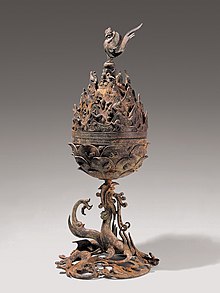
Baekje was founded as a member of the Mahan confederacy. Two sons of the founder of Goguryeo are recorded to have fled a succession conflict, to establish Baekje around the present Seoul area.[28] [29] [30]
Baekje captivated or conquered other Mahan chiefdoms and, at its elevation in the 4th century, controlled most of the western Korean peninsula. Buddhism was introduced to Baekje in 384 from Goguryeo, which Baekje welcomed.[25]
Baekje was a nifty maritime power;[31] its nautical skill, which made information technology the Phoenicia of Eastern asia, was instrumental in the dissemination of Buddhism throughout East asia and continental civilization to Japan.[32] [33] Baekje played a fundamental part in transmitting cultural and fabric developments to ancient Japan, including Chinese written characters, Chinese and Korean literature, technologies such equally ferrous metallurgy and ceramics, architectural styles, sericulture and Buddhism.[24] [25] [34] [35]
Baekje exerted its political influence on Tamna, a kingdom that ruled Jejudo. Baekje maintained a shut relationship with and extracted tribute from Tamna. Baekje'southward religious and artistic culture influenced Goguryeo and Silla.
Baekje was once a peachy military ability on the Korean Peninsula, especially during the time of Geunchogo,[36] just was critically defeated by Gwanggaeto and declined.[37]
In the late 5th century, under assault from Goguryeo, the capital of Baekje was moved south to Ungjin (present-mean solar day Gongju) and later further s to Sabi (present-twenty-four hour period Buyeo). Baekje was conquered past Silla-Tang alliance in 660, submitting the Unified Silla.
Silla [edit]

Co-ordinate to Korean records, in 57 BC, Seorabeol (or Saro, later Silla) in the southeast of the peninsula unified and expanded the confederation of city-states known as Jinhan. Although Samguk Sagi records that Silla was the earliest-founded of the three kingdoms, other written and archaeological records point that Silla was likely the last of the iii to establish a centralized government.
Silla was the smallest and weakest of the Three Kingdoms of Korea, just it used cunning diplomatic means to make opportunistic pacts and alliances with the more than powerful Korean kingdoms, and eventually Tang China, to its bang-up advantage.[38] [39]
Renamed from Saro to Silla in 503, the kingdom annexed the Gaya confederacy (which in turn had captivated Byeonhan earlier) in the commencement half of the sixth century. Goguryeo and Baekje responded by forming an alliance. To cope with invasions from Goguryeo and Baekje, Silla deepened its relations with the Tang Dynasty, with her newly gained admission to the Xanthous Ocean making direct contact with the Tang possible. After the conquest of Goguryeo and Baekje with her Tang allies, the Silla kingdom drove the Tang forces out of the peninsula and occupied the lands south of Pyongyang.
The capital of Silla was Seorabeol (now Gyeongju; "Seorabeol", "서라벌", is hypothesized to have been the ancient Korean term for "capital"). Buddhism became the official religion in 528. The remaining material civilisation from the kingdom of Silla including unique gold metalwork shows influence from the northern nomadic steppes, differentiating it from the civilization of Goguryeo and Baekje where Chinese influence was more pronounced.
Other states [edit]
Other smaller states or regions existed in Korea before and during this period:
- Gaya confederacy, Gaya was a confederacy of small-scale kingdoms in the Nakdong River valley of southern Korea since Advertisement 42, growing out of the Byeonhan confederacy of the Samhan period. Constantly engaged in war with the three kingdoms surrounding it, Gaya was not developed to form a unified state, and was ultimately absorbed into Silla in 562.
- Dongye, Okjeo, and Buyeo, all iii conquered by Goguryeo
- Usan (Ulleung-do) tributary of Silla
- Tamna (Jeju-exercise) tributary of Baekje

Organized religion [edit]
Centuries after Buddhism originated in Bharat, the Mahayana Buddhism arrived in Mainland china through the Silk Route in 1st century CE via Tibet, so to Korean peninsula in 3rd century during the Three Kingdoms Menses from where it transmitted to Japan. In Korea, it was adopted by the state religion by three elective polities of the 3 Kingdoms Period, first past the Goguryeo ruling tribe of Geumgwan Gaya in 372 CE, past the Silla in 528 CE, and by the Baekje in 552 CE.[4]
Decline [edit]
Allied with China under the Tang dynasty, Silla conquered Goguryeo in 668, after having already conquered Gaya in 562 and Baekje in 660, thus ushering in the N-Southward states period with Later Silla to the south and Balhae to the north, when Dae Jo-young, a former Goguryeo military officer, revolted against Tang Chinese rule and began reconquering former Goguryeo territories.
Archaeological evidence [edit]

An unusual drinking vessel excavated from a Gaya mounded burial.
Archaeologists utilise theoretical guidelines derived from anthropology, ethnology, illustration, and ethnohistory to the concept of what defines a state-level society. This is dissimilar from the concept of state (guk or Sino ko: 國, walled-town state, etc.) in the subject of Korean History.
In anthropological archaeology the presence of urban centres (especially capitals), monumental architecture, craft specialization and standardization of production, ostentatious burials, writing or recording systems, bureaucracy, demonstrated political command of geographical areas that are usually larger in area than a single river valley, etc. make upwards some of these correlates that define states.[40] Amid the archæology sites dating to the Three Kingdoms of Korea, hundreds of cemeteries with thousands of burials have been excavated. The vast majority of archaeological evidence of the Iii Kingdoms Period of Korea consists of burials, merely since the 1990s in that location has been a great increment in the archaeological excavations of ancient industrial production sites, roads, palace grounds and elite precincts, ceremonial sites, commoner households, and fortresses due to the boom in relieve archæology in S Korea.
Rhee and Choi hypothesize that a mix of internal developments and external factors pb to the emergence of state-level societies in Korea.[40] A number of archaeologists including Kang demonstrate the part of frequent warfare in the development of peninsular states.[40] [41] [42]
Foundation (c. 0 – 300/400 Advertisement) [edit]

Historic example of a climbing kiln similar to those that were excavated from Songok-dong and Mulcheon-ri equally early as the belatedly Three Kingdoms Menses, c. 600.
Some individual correlates of complex societies are found in the chiefdoms of Korea that date back to c. 700 BC (e.g. see Igeum-dong, Songguk-ri).[40] [43] Nonetheless, the all-time evidence from the archaeological record in Korea indicates that states formed betwixt 300 BC and 300/400 AD.[41] [42] [44] [45] [46] [47] However, archaeologists are not prepared to suggest that this ways there were states in the BC era. The correlates of state-level societies did non develop as a package, but rather in spurts and starts and at various points in time. It was some fourth dimension between 100–400 Advertising that private correlates of state societies had developed to a sufficient number and calibration that land-level societies can exist confidently identified using archaeological data.
Burials [edit]
Lee Sung-Joo analyzed variability in many of the aristocracy cemeteries of the territories of Silla and Gaya polities and found that as belatedly equally the 2nd century there was intra-cemetery variation in the distribution of prestige grave goods, just there was an absence of hierarchical differences on a regional scale between cemeteries. Near the finish of the 2d century Advertizement, interior space in aristocracy burials increased in size, and wooden chamber burial construction techniques were increasingly used past elites. In the 3rd century, a blueprint developed in which unmarried elite cemeteries that were the highest in status compared to all the other cemeteries were built. Such cemeteries were established at loftier elevations along ridgelines and on hilltops. Furthermore, the uppermost elite were buried in big-scale tombs established at the highest point of a given cemetery.[46] Cemeteries with 'uppermost elite' mounded burials such as Okseong-ri, Yangdong-ri, Daeseong-dong, and Bokcheon-dong display this pattern.

Mill-calibration production of pottery and roof-tiles [edit]
Lee Sung-Joo proposed that, in addition to the development of regional political hierarchies as seen through analysis of burials, variation in types of pottery product gradually disappeared and total-time specialization was the but recognizable kind of pottery product from the end of the 4th century A.D. At the same time the production centers for pottery became highly centralized and vessels became standardized.[46]
Centralisation and elite control of production is demonstrated by the results of the archaeological excavations at Songok-dong and Mulcheon-ni in Gyeongju. These sites are part of what was an interconnected and sprawling ancient industrial complex on the northeast outskirts of the Silla uppercase. Songok-dong and Mulcheon-ri are an example of the large-calibration of specialized factory-style production in the Three Kingdoms and Unified Silla Periods. The site was excavated in the late 1990s, and archaeologists found the remains of many production features such as pottery kilns, roof-tile kilns, charcoal kilns, likewise as the remains of buildings and workshops associated with production.
Uppercase cities, elite precincts, and monumental architecture [edit]
Since the establishment of Goguryeo, its early on history is well attested archaeologically: The outset and second capital cities, Jolbon and Gungnae metropolis, are located in and effectually today'southward Ji'an, Jilin. In 2004, the site was designated as a Earth Heritage Site by UNESCO. Since 1976, standing archaeological excavations concentrated in the southeastern part of mod Gyeongju have revealed parts of the so-called Silla Wanggyeong (Silla royal capital). A number of excavations over the years have revealed temples such equally Hwangnyongsa, Bunhwangsa, Heungryunsa, and 30 other sites. Signs of Baekje's capitals accept also been excavated at the Mongchon Fortress and the Pungnap Fortress in Seoul.
See also [edit]
- Heavenly Horse Tomb
- List of Korean monarchs
- Samguk Yusa
References [edit]
- ^ author., Peterson, Mark, 1946- (2010). A brief history of Korea. ISBN978-1-78785-286-0. OCLC 1112020757.
- ^ Kotkin, Stephen; Wolff, David (2015-03-04). Rediscovering Russia in Asia: Siberia and the Russian Far East: Siberia and the Russian Far Eastward. Routledge. ISBN9781317461296 . Retrieved fifteen July 2016.
- ^ The National Folk Museum of Korea (Republic of korea) (2014). Encyclopedia of Korean Folk Literature: Encyclopedia of Korean Folklore and Traditional Culture Vol. III. 길잡이미디어. p. 41. ISBN9788928900848 . Retrieved 10 September 2017.
- ^ a b Lee Injae, Owen Miller, Park Jinhoon, Yi Hyun-Hae, 2014, Korean History in Maps, Cambridge Academy Press, pp. 44-49, 52-60.
- ^ Vovin, Alexander (2006). "Why Manchu and Jurchen Wait so United nations-Tungusic ?". In Juha Janhunenn; Alessandra Pozzi; Michael Weiers (eds.). Tumen jalafun jecen akū: Festschrift for Giovanni Stary'southward 60th birthday. Harrassowitz. pp. 255–266.
- ^ Richard, Zgusta (2015). The Peoples of Northeast Asia through Fourth dimension Precolonial Ethnic and Cultural Processes along the Declension betwixt Hokkaido and the Bering Strait. ISBN978-90-04-30043-nine.
- ^ Tsiporuha Mikhail Isaakovich (2017). "История тунгусских племен мохэ и государства Бохай" [The history of Mohé and Bohai Tungusic tribes]. Покорение Сибири. От Ермака до Беринга . Retrieved 2021-04-18 .
- ^ [[ ]]
- ^ a b c d east f g 이기환 (30 August 2017). "[이기환의 흔적의 역사]국호논쟁의 전말…대한민국이냐 고려공화국이냐". 경향신문 (in Korean). The Kyunghyang Shinmun. Retrieved two July 2018.
- ^ a b c d 이덕일. "[이덕일 사랑] 대~한민국". 조선닷컴 (in Korean). Chosun Ilbo. Retrieved 2 July 2018.
- ^ a b c "고현묘지명(高玄墓誌銘)". 한국금석문 종합영상정보시스템. National Research Institute of Cultural Heritage. Retrieved x September 2018.
- ^ a b Deok-immature, Kwon (2014). "An inquiry into the name of Three Kingdom(三國) inscribed on the epitaph of T'ang(唐) period". The Journal of Korean Ancient History (in Korean). 75: 105–137. ISSN 1226-6213. Retrieved 2 July 2018.
- ^ Pai, Hyung Il (2000), Constructing "Korean" Origins: A Critical Review of Archæology, Historiography, and Racial Myth in Korean State Germination Theories, Harvard University Asia Center, pp. 127–129, ISBN9780674002449
- ^ United States Congress (2016). Due north Korea: A Country Study. Nova Science Publishers. p. 6. ISBN978-1590334430.
- ^ Connor, Edgar 5. (2003). Korea: Current Problems and Historical Groundwork. Nova Science Publishers. p. 112. ISBN978-1590334430.
- ^ Kim, Jinwung (2012). A History of Korea: From "State of the Morning Calm" to States in Conflict. Indiana University Press. p. 18. ISBN978-0253000248.
- ^ Lee, Peter H. (1993). Sourcebook of Korean Civilization. Columbia University Press. p. 227. ISBN978-0231079129.
- ^ Hong, Wontack (2005). "The Puyeo-Koguryeo Ye-maek the Sushen-Yilou Tungus, and the Xianbei Yan" (PDF). East Asian History: A Korean Perspective. 1 (12): one–7.
- ^ Yi, Ki-baek (1984). A New History of Korea. Harvard University Press. pp. 23–24. ISBN9780674615762 . Retrieved 21 November 2016.
- ^ Walker, Hugh Dyson (Nov 2012). East asia: A New History. AuthorHouse. p. 104. ISBN9781477265161 . Retrieved 21 November 2016.
- ^ Roberts, John Morris; Westad, Odd Arne (2013). The History of the Globe. Oxford University Press. p. 443. ISBN9780199936762 . Retrieved 15 July 2016.
- ^ Gardner, Hall (2007-11-27). Averting Global War: Regional Challenges, Overextension, and Options for American Strategy. Palgrave Macmillan. pp. 158–159. ISBN9780230608733 . Retrieved 15 July 2016.
- ^ Laet, Sigfried J. de (1994). History of Humanity: From the seventh to the sixteenth century. UNESCO. p. 1133. ISBN9789231028137 . Retrieved x October 2016.
- ^ a b Walker, Hugh Dyson (2012-11-20). Eastern asia: A New History. AuthorHouse. pp. vi–7. ISBN9781477265178 . Retrieved 21 November 2016.
- ^ a b c Korea'due south Three Kingdoms Archived 2011-05-16 at the Wayback Automobile. Ancientworlds.net (2005-06-nineteen). Retrieved on 2015-eleven-15.
- ^ Kim, Jinwung (2012-eleven-05). A History of Korea: From "Land of the Morning Calm" to States in Conflict. Indiana University Press. p. 35. ISBN978-0253000781 . Retrieved xi October 2016.
- ^ "Kings and Queens of Korea". KBS Earth Radio. Korea Communications Commission. Retrieved vii Oct 2016.
- ^ Pratt, Chairman Department of East Asian Studies Keith; Pratt, Keith; Rutt, Richard (2013-12-16). Korea: A Historical and Cultural Lexicon. Routledge. p. 135. ISBN9781136793936 . Retrieved 22 July 2016.
- ^ Yu, Chai-Shin (2012). The New History of Korean Civilization. iUniverse. p. 27. ISBN9781462055593 . Retrieved 22 July 2016.
- ^ Kim, Jinwung (2012-11-05). A History of Korea: From "Country of the Morning Calm" to States in Conflict. Indiana University Press. p. 28. ISBN978-0253000781 . Retrieved 22 July 2016.
- ^ Ebrey, Patricia Buckley; Walthall, Anne; Palais, James B. (2006). East Asia: A Cultural, Social, and Political History. Houghton Mifflin. p. 123. ISBN9780618133840 . Retrieved 12 September 2016.
- ^ Kitagawa, Joseph (2013-09-05). The Religious Traditions of Asia: Religion, History, and Culture. Routledge. p. 348. ISBN9781136875908 . Retrieved 29 July 2016.
- ^ Ebrey, Patricia Buckley; Walthall, Anne; Palais, James B. (2013). East asia: A Cultural, Social, and Political History, Volume I: To 1800. Cengage Learning. p. 104. ISBN978-1111808150 . Retrieved 12 September 2016.
- ^ Introduction Buddhism of Baekje into Japan. baekje.chungnam.net
- ^ Farris, William Wayne, Nippon to 1600: A Social and Economic History. Honolulu: Academy of Hawaii Printing, 2009, pp 68–87, 97-99, 101-105, 109-110, 116, 120–122.
- ^ A Brief History of Korea. Ewha Womans University Press. 2005-01-01. pp. 29–30. ISBN9788973006199 . Retrieved 21 November 2016.
- ^ Yu, Chai-Shin (2012). The New History of Korean Civilization. iUniverse. p. 27. ISBN9781462055593 . Retrieved 21 November 2016.
- ^ Kim, Jinwung (2012). A History of Korea: From "State of the Morning Calm" to States in Disharmonize. Indiana University Press. pp. 44–45. ISBN978-0253000248 . Retrieved 12 September 2016.
- ^ Wells, Kenneth M. (2015-07-03). Korea: Outline of a Civilization. BRILL. pp. 18–nineteen. ISBN9789004300057 . Retrieved 12 September 2016.
- ^ a b c d Rhee, S.N. & Choi, K.50. (1992). "Emergence of circuitous guild in Korea". Journal of World Prehistory. 6: 51–95. doi:ten.1007/BF00997585. S2CID 145722584.
- ^ a b Kang, Bong-won. (1995). The office of warfare in the formation of land in Korea: Historical and archaeological approaches. PhD dissertation. University of Oregon, Eugene. Ann Arbor: University Microfilms.
- ^ a b Kang, Bong-won (2000). "A test of increasing warfare in the Samguk Sagi against the archaeological remains in Yongnam, Republic of korea". Journal of Due east Asian Archaeology. 2 (3): 139–197. doi:10.1163/156852300760222100.
- ^ Bale, Martin T. & Ko, Min-jung (2006). "Arts and crafts Product and Social Alter in Mumun Pottery Period Korea". Asian Perspectives. 45 (ii): 159–187. doi:10.1353/asi.2006.0019. hdl:10125/17250. S2CID 55944795.
- ^ Barnes, Gina L. (2001). State formation in Korea: Historical and archaeological perspectives. Richmond, Surrey: Curzon. ISBN 0-7007-1323-9
- ^ Barnes, Gina L. (2004). "The emergence and expansion of Silla from an archaeological perspective". Korean Studies. 28: 14–48. doi:10.1353/ks.2005.0018. JSTOR 23720181. S2CID 162119593.
- ^ a b c Lee, Sung-joo. (1998). Silla–Gaya Sahwoe-eui Giwon-gwa Seongjang [The Ascent and Growth of Society in Silla and Gaya]. Seoul: Hakyeon Munhwasa.
- ^ Pai, Hyung Il. (1989). "Lelang and the "interaction sphere": An culling arroyo to Korean land formation". Archaeological Review from Cambridge. 8 (one): 64–75.
Further reading [edit]
- All-time, J.W. (2003). "Buddhism and polity in early sixth-century Paekche". Korean Studies. 26 (2): 165–215. doi:10.1353/ks.2004.0001. JSTOR 23719761. S2CID 154855624.
- Lee, Chiliad. (1984) [1979]. A New History of Korea . Tr. past E.W. Wagner & East.J. Schulz. Seoul: Ilchogak. p. 518. ISBN9780674615762.
- Na, H.L. (2003). "Ideology and religion in ancient Korea". Korea Periodical. 43 (4): x–29. Archived from the original on June fourteen, 2011.
- Nelson, Sarah Thousand. (1993). The archaeology of Korea. Cambridge: Cambridge University Printing. ISBN9780521407830.
- Pearson, R; Lee, J.W.; Koh, West.Y.; Underhill, A. (1989). "Social ranking in the Kingdom of Quondam Silla, Korea: Analysis of burials". Periodical of Anthropological Archæology. 8 (1): ane–50. doi:10.1016/0278-4165(89)90005-6. Scopus: 2-s2.0-38249024295.
External links [edit]
- Three Kingdoms Menses - World History Encyclopedia
- Korea's Iii Kingdoms
guerrieromusbacked.blogspot.com
Source: https://en.wikipedia.org/wiki/Three_Kingdoms_of_Korea
0 Response to "Korean Art During the Three Kingdoms Period Is Known for"
Post a Comment