what contributed to the emergence of landscape painting during the six dynasties period of china?
| Chinese painting | |||||||
|---|---|---|---|---|---|---|---|
 A hanging coil Chinese painting by Ma Lin in 13th Century. Ink and color on silk, 226.6x110.3 cm. | |||||||
 Danqing painting, a department of Wang Ximeng's A M Li of Rivers and Mountains ( 千里江山圖 ). | |||||||
| Traditional Chinese | 中國畫 | ||||||
| Simplified Chinese | 中国画 | ||||||
| |||||||
Chinese painting (simplified Chinese: 中国画; traditional Chinese: 中國畫; pinyin: Zhōngguó huà ) is one of the oldest continuous creative traditions in the world. Painting in the traditional style is known today in Chinese as guó huà (simplified Chinese: 国画; traditional Chinese: 國畫), pregnant "national painting" or "native painting", as opposed to Western styles of fine art which became pop in Mainland china in the 20th century. Information technology is also called danqing (Chinese: 丹青; pinyin: dān qīng ). Traditional painting involves essentially the same techniques as calligraphy and is done with a brush dipped in blackness ink or coloured pigments; oils are non used. As with calligraphy, the almost popular materials on which paintings are made are newspaper and silk. The finished work can be mounted on scrolls, such every bit hanging scrolls or handscrolls. Traditional painting tin can also be done on anthology sheets, walls, lacquerware, folding screens, and other media.
The two main techniques in Chinese painting are:
- Gongbi (工筆), pregnant "meticulous", uses highly detailed brushstrokes that delimit details very precisely. It is often highly colored and usually depicts figural or narrative subjects. It is ofttimes proficient by artists working for the royal court or in independent workshops.
- Ink and wash painting, in Chinese shuǐ-mò (水墨, "h2o and ink") also loosely termed watercolor or brush painting, and too known equally "literati painting", equally it was one of the "iv arts" of the Chinese Scholar-official class.[one] In theory this was an art proficient by gentlemen, a distinction that begins to be made in writings on fine art from the Song dynasty, though in fact the careers of leading exponents could benefit considerably.[two] This style is as well referred to equally "xieyi" (寫意) or freehand manner.
Mural painting was regarded as the highest form of Chinese painting, and mostly still is.[three] The fourth dimension from the Five Dynasties menstruation to the Northern Song period (907–1127) is known every bit the "Great historic period of Chinese landscape". In the north, artists such as Jing Hao, Li Cheng, Fan Kuan, and Guo 11 painted pictures of towering mountains, using stiff black lines, ink wash, and abrupt, dotted brushstrokes to advise rough rock. In the south, Dong Yuan, Juran, and other artists painted the rolling hills and rivers of their native countryside in peaceful scenes done with softer, rubbed brushwork. These 2 kinds of scenes and techniques became the classical styles of Chinese landscape painting.
Specifics and study [edit]
Chinese painting and calligraphy distinguish themselves from other cultures' arts by emphasis on move and change with dynamic life.[4] The practise is traditionally first learned by rote, in which the master shows the "correct way" to depict items. The apprentice must re-create these items strictly and continuously until the movements become instinctive. In contemporary times, debate emerged on the limits of this copyist tradition inside modernistic art scenes where innovation is the rule. Changing lifestyles, tools, and colors are also influencing new waves of masters.[four] [5]
Early periods [edit]


The earliest paintings were not representational but ornamental; they consisted of patterns or designs rather than pictures. Early pottery was painted with spirals, zigzags, dots, or animals. It was only during the Eastern Zhou (770–256 BC) that artists began to represent the world around them. In imperial times (beginning with the Eastern Jin dynasty), painting and calligraphy in China were among the nearly highly appreciated arts in the court and they were often proficient past amateurs—aristocrats and scholar-officials—who had the leisure time necessary to perfect the technique and sensibility necessary for not bad brushwork. Calligraphy and painting were thought to exist the purest forms of art. The implements were the brush pen fabricated of fauna pilus, and blackness inks fabricated from pine soot and beast glue. In ancient times, writing, likewise as painting, was done on silk. However, after the invention of newspaper in the 1st century Ad, silk was gradually replaced by the new and cheaper material. Original writings past famous calligraphers have been profoundly valued throughout China'due south history and are mounted on scrolls and hung on walls in the same fashion that paintings are.
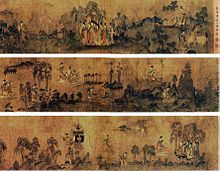
Artists from the Han (206 BC – 220 Advertising) to the Tang (618–906) dynasties mainly painted the human effigy. Much of what nosotros know of early Chinese figure painting comes from burial sites, where paintings were preserved on silk banners, lacquered objects, and tomb walls. Many early tomb paintings were meant to protect the dead or help their souls to get to paradise. Others illustrated the teachings of the Chinese philosopher Confucius or showed scenes of daily life.
During the Half-dozen Dynasties period (220–589), people began to appreciate painting for its own beauty and to write well-nigh fine art. From this time we brainstorm to acquire well-nigh individual artists, such as Gu Kaizhi. Even when these artists illustrated Confucian moral themes – such as the proper beliefs of a married woman to her husband or of children to their parents – they tried to make the figures svelte.
Six principles [edit]
The "Six principles of Chinese painting" were established past Xie He, a writer, fine art historian and critic in 5th century Red china, in "Six points to consider when judging a painting" (繪畫六法, Pinyin: Huìhuà Liùfǎ), taken from the preface to his book "The Record of the Classification of Former Painters" (古畫品錄; Pinyin: Gǔhuà Pǐnlù). Keep in mind that this was written circa 550 CE and refers to "old" and "ancient" practices. The six elements that define a painting are:

- "Spirit Resonance", or vitality, which refers to the flow of free energy that encompasses theme, work, and artist. Xie He said that without Spirit Resonance, at that place was no demand to wait further.
- "Bone Method", or the way of using the castor, refers not only to texture and brush stroke, but to the close link between handwriting and personality. In his solar day, the art of calligraphy was inseparable from painting.
- "Correspondence to the Object", or the depicting of form, which would include shape and line.
- "Suitability to Blazon", or the awarding of color, including layers, value, and tone.
- "Division and Planning", or placing and arrangement, respective to composition, space, and depth.
- "Transmission by Copying", or the copying of models, not from life only but too from the works of artifact.
Sui, Tang and Five dynasties (581–979) [edit]

During the Tang dynasty, figure painting flourished at the majestic courtroom. Artists such as Zhou Fang depicted the splendor of court life in paintings of emperors, palace ladies, and regal horses. Effigy painting reached the acme of elegant realism in the art of the court of Southern Tang (937–975).
Most of the Tang artists outlined figures with fine black lines and used brilliant colour and elaborate detail. All the same, i Tang artist, the primary Wu Daozi, used just blackness ink and freely painted brushstrokes to create ink paintings that were so exciting that crowds gathered to watch him work. From his time on, ink paintings were no longer idea to be preliminary sketches or outlines to be filled in with color. Instead, they were valued as finished works of art.
Beginning in the Tang Dynasty, many paintings were landscapes, often shanshui (山水, "mountain water") paintings. In these landscapes, monochromatic and sparse (a style that is collectively called shuimohua), the purpose was not to reproduce the appearance of nature exactly (realism) simply rather to grasp an emotion or atmosphere, as if communicable the "rhythm" of nature.
Song, Liao, Jin and Yuan dynasties (907–1368) [edit]


Painting during the Song dynasty (960–1279) reached a further development of landscape painting; immeasurable distances were conveyed through the utilise of blurred outlines, mountain contours disappearing into the mist, and impressionistic handling of natural phenomena. The shan shui style painting—"shan" significant mountain, and "shui" meaning river—became prominent in Chinese landscape art. The emphasis laid upon landscape was grounded in Chinese philosophy; Taoism stressed that humans were but tiny specks in the vast and greater cosmos, while Neo-Confucianist writers oftentimes pursued the discovery of patterns and principles that they believed caused all social and natural phenomena.[6] The painting of portraits and closely viewed objects like birds on branches were held in high esteem, simply landscape painting was paramount.[vii] Past the beginning of the Song Dynasty a distinctive landscape style had emerged.[8] Artists mastered the formula of intricate and realistic scenes placed in the foreground, while the background retained qualities of vast and space space. Distant mountain peaks rise out of loftier clouds and mist, while streaming rivers run from afar into the foreground.[ix]
There was a significant difference in painting trends between the Northern Song period (960–1127) and Southern Song menstruum (1127–1279). The paintings of Northern Vocal officials were influenced past their political ideals of bringing order to the world and tackling the largest bug affecting the whole of order; their paintings oft depicted huge, sweeping landscapes.[10] On the other hand, Southern Song officials were more interested in reforming society from the bottom upwardly and on a much smaller scale, a method they believed had a better risk for eventual success; their paintings often focused on smaller, visually closer, and more intimate scenes, while the groundwork was ofttimes depicted as insufficient of detail as a realm without concern for the artist or viewer.[10] This change in attitude from one era to the next stemmed largely from the ascent influence of Neo-Confucian philosophy. Adherents to Neo-Confucianism focused on reforming order from the lesser up, not the top down, which can be seen in their efforts to promote small private academies during the Southern Song instead of the large state-controlled academies seen in the Northern Song era.[11]
Ever since the Southern and Northern dynasties (420–589), painting had become an art of high sophistication that was associated with the gentry form as one of their main creative pastimes, the others being calligraphy and poetry.[12] During the Vocal Dynasty in that location were avid fine art collectors that would ofttimes see in groups to discuss their own paintings, likewise as rate those of their colleagues and friends. The poet and statesman Su Shi (1037–1101) and his cohort Mi Fu (1051–1107) oft partook in these diplomacy, borrowing fine art pieces to study and re-create, or if they actually admired a piece then an exchange was oftentimes proposed.[13] They created a new kind of art based upon the three perfections in which they used their skills in calligraphy (the art of cute writing) to make ink paintings. From their time onward, many painters strove to freely express their feelings and to capture the inner spirit of their bailiwick instead of describing its outward appearance. The small round paintings popular in the Southern Song were often collected into albums equally poets would write poems along the side to match the theme and mood of the painting.[10]

The "Four Generals of Zhongxing" painted by Liu Songnian during the Southern Song dynasty. Yue Fei is the second person from the left. It is believed to be the "truest portrait of Yue in all extant materials".[xiv]
Although they were gorging art collectors, some Song scholars did not readily appreciate artworks commissioned past those painters establish at shops or common marketplaces, and some of the scholars fifty-fifty criticized artists from renowned schools and academies. Anthony J. Barbieri-Low, a Professor of Early on Chinese History at the University of California, Santa Barbara, points out that Song scholars' appreciation of art created past their peers was not extended to those who made a living simply as professional artists:[15]
During the Northern Song (960–1126 CE), a new course of scholar-artists emerged who did not possess the tromp fifty'œil skills of the university painters nor even the proficiency of mutual marketplace painters. The literati'due south painting was simpler and at times quite unschooled, yet they would criticize these other 2 groups as mere professionals, since they relied on paid commissions for their livelihood and did non paint just for enjoyment or self-expression. The scholar-artists considered that painters who concentrated on realistic depictions, who employed a colorful palette, or, worst of all, who accepted budgetary payment for their work were no better than butchers or tinkers in the market. They were not to be considered real artists.[15]
Withal, during the Song flow, there were many acclaimed court painters and they were highly esteemed past emperors and the purple family. One of the greatest landscape painters given patronage past the Vocal court was Zhang Zeduan (1085–1145), who painted the original Along the River During the Qingming Festival scroll, i of the most well-known masterpieces of Chinese visual art. Emperor Gaozong of Vocal (1127–1162) once commissioned an art project of numerous paintings for the Eighteen Songs of a Nomad Flute, based on the woman poet Cai Wenji (177–250 AD) of the before Han dynasty. Yi Yuanji accomplished a high degree of realism painting animals, in particular monkeys and gibbons.[16] During the Southern Vocal flow (1127–1279), court painters such equally Ma Yuan and Xia Gui used stiff black brushstrokes to sketch trees and rocks and pale washes to advise misty infinite.
During the Mongol Yuan dynasty (1271–1368), painters joined the arts of painting, poetry, and calligraphy by inscribing poems on their paintings. These three arts worked together to limited the artist's feelings more completely than i art could exercise alone. Yuan emperor Tugh Temur (r. 1328, 1329–1332) was fond of Chinese painting and became a creditable painter himself.
The Chinese are of all peoples the most good in crafts and reach the greatest perfection in them. This is well known and people accept described it and spoken at length about it. No one, whether Greek or any other, rivals them in mastery of painting. They take biggy facility in information technology. 1 of the remarkable things I saw in this connectedness is that if I visited 1 of their cities, and and then came back to it, I always saw portraits of me and my companions painted on the walls and on paper in the bazaars. I went to the Sultan's urban center, passed through the painters' boutique, and went to the Sultan's palace with my companions. Nosotros were dressed every bit Iraqis. When I returned from the palace in the evening I passed through the said bazaar. I saw my and my companions' portraits painted on paper and hung on the walls. We each one of us looked at the portrait of his companion; the resemblance was correct in all respects. I was told the Sultan had ordered them to do this, and that they had come to the palace while we were there and had begun observing and painting us without our being aware of it. Information technology is their custom to paint everyone who comes among them.[17]
Late imperial China (1368–1895) [edit]

The panorama painting "Difference Herald", painted during the reign of the Xuande Emperor (1425–1435 Ad), shows the emperor traveling on horseback with a big escort through the countryside from Beijing's Imperial City to the Ming Dynasty tombs. Beginning with Yongle, thirteen Ming emperors were buried in the Ming Tombs of present-day Changping District.
Outset in the 13th century, the tradition of painting simple subjects—a branch with fruit, a few flowers, or 1 or two horses—developed. Narrative painting, with a wider color range and a much busier limerick than Song paintings, was immensely popular during the Ming period (1368–1644).

The outset books illustrated with colored woodcuts appeared around this time; as color-printing techniques were perfected, illustrated manuals on the art of painting began to exist published. Jieziyuan Huazhuan (Manual of the Mustard Seed Garden), a five-book work first published in 1679, has been in use as a technical textbook for artists and students e'er since.
Some painters of the Ming dynasty (1368–1644) continued the traditions of the Yuan scholar-painters. This group of painters, known as the Wu Schoolhouse, was led by the artist Shen Zhou. Another grouping of painters, known every bit the Zhe School, revived and transformed the styles of the Vocal court.

Shen Zhou of the Wu School depicted the scene when the painter was making his farewell to Wu Kuan, a skillful friend of his, at Jingkou.
During the early Qing dynasty (1644–1911), painters known equally Individualists rebelled against many of the traditional rules of painting and found ways to limited themselves more direct through costless brushwork. In the 18th and 19th centuries, great commercial cities such every bit Yangzhou and Shanghai became art centers where wealthy merchant-patrons encouraged artists to produce bold new works. Yet, similar to the phenomenon of key lineages producing, many well-known artists came from established artistic families. Such families were concentrated in the Jiangnan region and produced painters such as Ma Quan, Jiang Tingxi, and Yun Zhu.[18]

A View of Henan Island (Honam), County, Qing dynasty
It was also during this period when Chinese trade painters emerged. Taking reward of British and other European traders in popular port cities such as County, these artists created works in the Western style particularly for Western traders. Known as Chinese export paintings, the trade thrived throughout the Qing Dynasty.
In the tardily 19th and 20th centuries, Chinese painters were increasingly exposed to Western art. Some artists who studied in Europe rejected Chinese painting; others tried to combine the best of both traditions. Among the most dearest modern painters was Qi Baishi, who began life equally a poor peasant and became a great master. His best-known works draw flowers and small animals.

Shop of Tingqua, the painter
Modernistic painting [edit]

"Portrait of Madame Liu" (1942) Li Tiefu
Beginning with the New Civilisation Movement, Chinese artists started to adopt using Western techniques. Prominent Chinese artists who studied Western painting include Li Tiefu, Yan Wenliang, Xu Beihong, Lin Fengmian, Fang Ganmin and Liu Haisu.
In the early years of the People's Commonwealth of China, artists were encouraged to employ socialist realism. Some Soviet Wedlock socialist realism was imported without modification, and painters were assigned subjects and expected to mass-produce paintings. This regimen was considerably relaxed in 1953, and after the Hundred Flowers Campaign of 1956–57, traditional Chinese painting experienced a pregnant revival. Forth with these developments in professional art circles, there was a proliferation of peasant art depicting everyday life in the rural areas on wall murals and in open up-air painting exhibitions.
During the Cultural Revolution, art schools were closed, and publication of fine art journals and major art exhibitions ceased. Major devastation was also carried out as part of the elimination of Four Olds campaign.
Since 1978 [edit]
Post-obit the Cultural Revolution, art schools and professional organizations were reinstated. Exchanges were gear up up with groups of foreign artists, and Chinese artists began to experiment with new subjects and techniques. Ane particular example of freehand style (xieyi hua) may be noted in the piece of work of the child prodigy Wang Yani (born 1975) who started painting at age 3 and has since considerably contributed to the exercise of the fashion in contemporary artwork.
After Chinese economic reform, more and more artists boldly conducted innovations in Chinese Painting. The innovations include: evolution of new brushing skill such as vertical direction splash h2o and ink, with representative artist Tiancheng Xie,[ citation needed ] creation of new style by integration traditional Chinese and Western painting techniques such as Heaven Style Painting, with representative artist Shaoqiang Chen,[nineteen] and new styles that express contemporary theme and typical nature scene of sure regions such as Lijiang Painting Style, with representative artist Gesheng Huang.[ citation needed ] A 2008 ready of paintings by Cai Jin, virtually well known for her use of psychedelic colors, showed influences of both Western and traditional Chinese sources, though the paintings were organic abstractions.[xx]
Contemporary Chinese Art [edit]
Chinese painting continues to play an essential role in Chinese cultural expression. Starting mid-twentieth century, artists begin to combine traditional Chinese painting techniques with Western art styles, leading to the style of new contemporary Chinese art. Ane of the representative artists is Wei Dong who drew inspirations from eastern and western sources to express national pride and make it at personal actualization.[21]
Iconography in Chinese painting [edit]
Water Manufacturing plant [edit]
As the landscape painting rose and became the dominant manner in N Song dynasty, artists began to shift their attention from jiehua painting, which indicates paintings of Chinese architectural objects such equally buildings, boats, wheels and vehicles, towards landscape paintings. Intertwining with the purple mural painting, water mill, an element of jiehua painting, though, is notwithstanding used as an imperial symbol. Water mill depicted in the Water Factory is a representation for the revolution of engineering, economy, scientific discipline, mechanical engineering and transportation in Song dynasty. Information technology represents the government straight participate in the milling manufacture which tin can influence commercial activities. Another evidence that shows the government interfered with the commercial is a wineshop that appears beside the water mill. The h2o mill in Shanghai Scroll reflects the development in engineering and growing knowledge in hydrology. Furthermore, a h2o mill can also exist used to identify a painting and used as a literature metaphor. Lately, the h2o mill transform into a symbolic form representing the imperial court.
A Grand Miles of Rivers and Mountains past Wang Ximeng, celebrates the imperial patronage and builds up a bridge that ties the later emperors, Huizong, Shenzong with their ancestors, Taizu and Taizong. The water factory in this painting, unlike that is painted in previous Shanghai scroll to be solid and weighted, information technology is painted to exist ambiguous and vague to match up with the court sense of taste of that time. The painting reflects a slow pace and peaceful idyllic manner of living. Located deeply in a village, the water manufacturing plant is driven by the forcefulness of a huge, vertical waterwheel which is powered by a sluice gate. The artist seems to be ignorance towards hydraulic technology since he only roughly drew out the mechanism of the whole procedure. A Thousand Miles of Rivers and Mountainspainted by Wang Ximeng, a court artist taught directly by Huizong himself. Thus, the artwork A Thousand Miles of Rivers and Mountainsshould directly review the taste of the majestic taste of the landscape painting. Combining richness brilliant blue and turquoise pigments heritage from Tang dynasty with the vastness and solemn space and mountains from Northern Song, the scroll is a perfect representation of imperial power and aesthetic gustation of the aristocrats.[22]
Image as Word: Rebus [edit]
There is a long tradition of having subconscious significant backside certain objects in Chinese paintings. A fan painting past an unknown artist from North Song period depicts three gibbons capturing baby egrets and scaring the parents abroad. The rebus backside this scene is interpreted as celebrating the examination success. Since another painting which has similar subjects—gibbons and egrets, is given the title of San yuan de lu三猿得鹭, or Iii gibbons communicable egrets. As the rebus, the sound of the title can too be written equally 三元得路, meaning "a triple first gains [one] power." 元represents "first" replaces its homophonous 猿, and 路means road, replaces 鹭. Sanyuan is firstly recorded equally a term referring to people getting triple first place in an exam in Qingsuo gaoyi by a N Song writer Liu Fu, and the usage of this new term gradually spread across the country where the scenery of gibbons and egrets is widely accepted. Lately, other scenery derived from the original paintings, including deer in the scene because in Chinese, deer, lu is too a homophonous of egrets. Moreover, the number of gibbons depicted in the painting can be flexible, not only express to three, sanyuan. Since the positions in Song courts are held by elites who achieved jinshi caste, the paintings with gibbons, egrets or deer are used for praising those elites in general.
Emperor Huizong personally painted a painting called Birds in a bloom wax-plum tree, features with 2 "hoary headed birds," "Baitou weng" resting on a tree branch together. "Baitou" in Chinese culture is allusion to faithful love and spousal relationship. In a well-known love poem, information technology wrote: "I wish for a lover in whose heart I lone exist, unseparated even our heads plough hoary." During Huizong's dominion, literati rebus is embedded in courtroom painting academy and became part of the test routine to enter the majestic court. During Song dynasty, the connection between painters and literati, paintings and poem is closer.[23]
The Ass Rider [edit]
"The country is broken; mountains and rivers remain." The verse form past Du Fu (712-770) reflects the major principle in Chinese culture: the dynasty might modify, only the landscape is eternal. This timelessness theme evolved from Six Dynasty flow and early Northern Song. A donkey passenger travelling through the mountains, rivers and villages is studied as an important iconographical graphic symbol in developing of mural painting.
The ass rider in the painting Travelers in a wintry forest by Li Cheng is assumed to exist a portrait painting of Meng Haoran, "a tall and lanky human being dressed in a scholar plain robe, riding on a small horse followed by a young servant." Except Meng Haoran, other famous people for case, Ruan Ji, one of the 7 sages of the Bamboo Grove and Du Fu, a younger gimmicky of Meng are likewise depicted as donkey passenger. Tang dynasty poets Jia Dao and Li He and early Song dynasty elites Pan Lang, Wang Anshi appears on the paintings as ass rider. Northward Song poets Lin Bu and Su Shi are lately depicted as ass rider. In this specific painting Travelers in a wintry forest, the potential candidates for the donkey rider are dismissed and the character can merely be Meng Haoran. Meng Haoran has made more than two hundred poems in his life but none of them is related with donkey ride. Depicting him as a donkey rider is a historical invention and Meng represents a general persona than an individual graphic symbol. Ruan Ji was depicted equally ass rider since he decided to escape the part life and went back to the wilderness. The donkey he was riding is representing his poverty and eccentricity. Du Fu was portrayed as the rider to accent his failure in role achievement and likewise his poor living condition. Meng Haoran, like to those 2 figures, disinterested in office career and acted as a pure scholar in the field of poem by writing real poems with real feel and existent emotional attachment with the landscape. The donkey rider is said to travel through fourth dimension and space. The audition are able to connect with the scholars and poets in the past by walking on the same route as those superior ancestors have gone on. Besides the donkey rider, at that place is always a bridge for the donkey to across. The span is interpreted to have symbolic significant that represents the road which hermits depart from capital metropolis and their official careers and go dorsum to the natural globe.[24]
Realm of the Immortals [edit]
During Song dynasty, paintings with themes ranging from animals, flower, mural and classical stories, are used as ornaments in imperial palace, authorities role and elites' residence for multiple purposes. The theme of the fine art in display is carefully picked to reflect non only a personal taste, simply also his social status and political achievement. In emperor Zhezong's lecture hall, a painting depicting stories form Zhou dynasty was hanging on the wall to remind Zhezong how to exist a skillful ruler of the empire. The painting also serves the purpose of expressing his determination to his courtroom officers that he is an enlightened emperor.
The main walls of the regime office, also chosen walls of the "Jade Hall," pregnant the residence of the immortals in Taoism are busy past decorative murals. Near educated and respected scholars were selected and given the title xueshi. They were divided into groups in helping the Instituted of Literature and were described as descending from the immortals. Xueshi are receiving high social condition and doing carefree jobs. Lately, the xueshi yuan, the place where xueshi lives, became the permanent government institution that helped the emperor to make imperial decrees.
During Tang dynasty reign of Emperor Xianzong (805-820), the west wall of the xueshi yuan was covered by murals depicting dragon-like mountain scene. In 820–822, immortal animals similar Mount Ao, flying cranes, and xianqin, a kind of immortal birds were added to the murals. Those immortal symbols all indicate that the xueshi yuan as eternal existing government part.
During Song dynasty, the xueshi yuan was modified and moved with the dynasty to the new capital Hangzhou in 1127. The mural painted by Song artist Dong yu, closely followed the tradition of Tang dynasty in depicting the misty sea surrounding the immortal mountains. The scenery on the walls of the Jade Hall which full of mist clouds and mysterious land is closely related to Taoism tradition. When Yan Su, a painter followed the style of Li Cheng, was invited to pigment the screen backside the seat of the emperor, he included elaborated constructed pavilions, mist clouds and mountain landscape painting in his work. The theme of his painting is suggesting the immortal realm which accord with the unabridged theme of the Jade Hall provides to its viewer the feeling of otherworldliness. Another painter, Guo Xi fabricated another screen painting for emperor Shenzong, depicting mountains in spring in a harmonized atmosphere. The epitome besides includes immortal elements Mount Tianlao which is ane of the realms of the immortals. In his painting, Early Spring, the stiff branches of the trees reflects the life force of the living creatures and implying the emperor'south chivalrous rule.[25]
Images of women [edit]
Female person characters are almost excluded from traditional Chinese painting under the influence of Confucianism. Dong Zhongshu, an influential Confucian scholar in the Han dynasty, proposed the three-bond theory proverb that: "the ruler is Yang and the bailiwick is Yin, male parent is Yang and son is Yin…The hubby is Yang, and the wife is Yin," which places females in a subordinate position to that of males. Under the three-bail theory, women are depicted as housewives who demand to obey to their husbands and fathers in literature. Similarly, in the portrait paintings, female person characters are also depicted as exemplary women to elevate the rule of males. A manus gyre Exemplary Womenpast Ku Kai Zhi, a six Dynasty artist, depicted adult female characters who may be a wife, a daughter or a widow.
During the Tang dynasty, artists slowly began to appreciate the dazzler of a woman's body (shinu). Artist Zhang Xuan produced painting named palace women listening to music that captured women's elegance and pretty faces. However, women were still being depicted as submissive and platonic within male arrangement.
During the Song dynasty, as the love poem emerged, the images associated with those beloved stories were made every bit attractive every bit possible to meet the gustatory modality of the male person viewers.[26]
Mural Painting [edit]

A timeline of Chinese landscape painting from early on Tang to the present day

A landscape painting past Guo Eleven. This piece shows a scene of deep and serene mountain valley covered with snowfall and several old trees struggling to survive on precipitous cliffs.
Prototype Shift in Chinese Mural Representation [edit]
Northern Vocal landscape painting dissimilar from Southern Song painting because of its paradigm shift in representation. If Southern Song menstruation landscape painting is said to be looking inward, Northern Vocal painting is reaching outward. During the Northern Song period, the rulers' goal is to consolidate and extend the elites value across the society. Whereas Southern Vocal painters decided to focus on personal expression. Northern Song landscapes are regarded every bit "real landscape", since the court appreciated the representation relationship between fine art and the external world, rather than the relationship betwixt art and the artists inner vocalism. The painting, A Thousand Miles of Rivers and Mountains is horizontally displayed and there are 4 mount ranges arranged from left to right. Similar to another early Southern Song painter, Zhou Boju, both artists glorified their patrons by presenting the gigantic empire images in blue and light-green mural painting. The just difference is that in Zhou'due south painting, there are five mountain ranges that arranges from right to left. The scenes in the Sothern Song paintings are nearly north landscape that echos the retentiveness of their lost n territory. Yet, ironically, some scholars suggested that Wang Ximeng's A Thousand Miles of Rivers and Mountains depicts the scenes of the south not the n.[27]
Buddhist and Taoist influences on Chinese Landscape painting [edit]
The Chinese landscape painting are believed to be affected by the intertwining Chinese traditional religious behavior, for example, "the Taoist dearest of nature", and "Buddhist principle of emptiness," and tin represent the diversification of artists attitudes and thoughts from previous period. The Taoist love of nature is not always present in Chinese landscape painting but gradually developed from Six Dynasties period when Taoists Lao-tzu, Chuang-tzu, the Pao-p'u tzu's thoughts are reflected in literature documents. Apart from the gimmicky Confucian tradition of insisting on homo tillage and learning to exist more educated and build up social framework, Taoist persist on going back to human'due south origin, which is to be ignorant. Taoists believe that if one discard wise, the robbery will stop. If people abandon expensive jewelry, thieves will non exist. From Han Dynasty, the practice of Taoism was associated with alchemical and medicine made. In order to amend pursuit Taoism conventionalities, Taoist need to go on pilgrim into specific mountains to connect themselves with the spirits and immortals that lived in those mountains. In the third and fourth century, the practice of escaping society and going dorsum to nature mediating in the countryside is further enhanced by a grouping chosen Seven Sages of the Bamboo Grove who would similar to escape from the ceremonious unrest. The wise men fleet the world and wonder in the countryside and enjoy the tranquil landscape and forgot to render. The Taoism credo of forgetfulness, self-cultivation, harmonizing with nature world, and purifying soul by entering the isolated mountains to mediate and seek medicine herbs create the scene of landscape painting.
During Han Dynasty, the mountains appeared in the pattern of the artworks shows the prevalence role of mount in Han social club. The emperor would climb on to the mount to sacrifice and religion practice considering mountains are thought to accept connection between earth and heaven and can link human with spirits and immortals. And sometimes, mountains are depicted as mystical mountains" (shenshan), where sages and legendary animals settled. Hence, landscape painting is used as an object for Taoism practice which provide visualize course for religious ritual. During Half dozen Dynasty period, the landscape painting experienced a stylistic change which myth and poem depiction were introduced into the painting. For example, in Ku Kai-chih's "Nymph of the river" scroll and "The Admonitions of the Court Preceptress", audition are able to read narrative description and text accompanied by visualized images.
Furthermore, in Buddhism practice, the mountain also has an important part in religious practice. From iconographical point of view, a Buddha'southward image is essence in helping a believer to exercise meditation. For example, Buddha's reflection prototype, or shadow, is alloyed the epitome of a mountain, Lushan. This absorption is also recorded in a poem by poet from Six Dynasty flow who pointed out that the beauty and nominosity of the mountain can elevate the spiritual connection between human and the spirits. Thus, the landscape painting come into display Buddha'due south image in people's everyday ritual practice. Hui-yuan described in his verse form that "Lushan seems to mirror the divine appearance" which unifies the two images—the truthful paradigm and the reflection of Buddha. Moreover, spiritual height can exist achieved past contemplating in front end of landscape painting which depict the aforementioned mount and path those old sages have been to. The painting contains both the spiritual force (ling) and the truth (li) of Buddha and also the objects that no longer physically presence. Hui-Yuan's famous image is closely relation with its landscape scene indicating the trend of transformation from Buddha paradigm to landscape painting as a religious practise.[28]
Early landscape painting [edit]
In Chinese society, there is a long-time appreciation of natural beauty. The early themes of poems, artworks are associated with agriculture and everyday life associates with fields, animals. On the other hand, later Chinese painting pursuits majesty and grand. Thus, mountain scenery become the well-nigh popular subject to pigment because information technology's high which stand for man eminence. Also, mountain is stable and permanent suggests the eminent of the purple ability. Furthermore, mount is hard to climb showing the difficulties human volition face through their lives.
Mural painting evolved under the influence of Taoist who fled from civil turbulence and prosecution of the government and went back to the wilderness. However, the evolution of Taoism was hindered by Han dynasty. During Han dynasty, the empire expanded and enlarged its political and economic influence. Hence, the Taoism'due south anti-social belief was disfavored by the imperial government. Han rulers only favored portrait painting which enabled their image to be perpetuate and their civilians to see and to memorize their neat leaders or generals. Landscape at that time only focus on the trees for literary or talismanic value. The usage of landscape painting as ornament is suspects to be borrowed from other societies outside Han empire during its expansion to the Near East. Mural and animal scene began to appear on the jars, merely the decoration has piffling to exercise with connection with the natural world. Also, there is evidence showing that the emerging of landscape painting is not derived from map-making.
During the Iii Kingdoms and Vi Dynasty, landscape painting began to take connection with literati and the production of poems. Taoism influence on people'south appreciation of landscaping deceased and nature worshipping superseded. However, Taoist withal used mural painting in their meditation just every bit Confucius uses portrait painting in their ritual practice. (Ku Kai Chih'south admonitions) During this fourth dimension catamenia, the landscape painting is more coherence with variation trees, rocks and branches. Moreover, the painting is more than elaborated and organized. The development in landscape painting during Six Dynasty is that artists harmonized sprit with the nature. (Wu Tao-tzu) Buddhism might besides contribute in affecting changes in landscape painting. The artists began to show infinite and depth in their works where they showed mountain mass, distanced hills and clouds. The emptiness of the infinite is helping the believers meditating to enter the space of emptiness and pettiness.
The nigh important development in landscape painting is that people came to recognize the infinity variation of the nature world, then they tended to make each tree individualized. Every mural painting is restricted by storytelling and is dependent on artists memory.[29]
Dyads [edit]
Chinese landscape painting, "shanshui hua" means the painting of mountains and rivers which are the two major components that represents the essence of the nature. Shanshui in Chinese tradition is given rich meaning, for example mountain represents Yang and river indicates Yin. According to Yin Yang theory, Yin embodies Yang and Yang involved in Yin, thus, mountain and river is inseparable and is treated as a whole in a painting. In the Mountains and rivers without end, for instance, "the dyad of the mountain uplift, subduction, and erosion and the planetary water bike" is consistent with the dyad of Buddhism iconography, both representing austerity and generous loving spirit.[30]
Art as cartography [edit]
"Arts in maps, arts as maps, maps in arts, and maps as arts," are the four relationships between fine art and map. Making a distinction between map and fine art is difficult because at that place are cartographic elements in both paintings. Early on Chinese map making considered globe surface equally flat, and then artists would not accept project into consideration. Moreover, map makers did not have the idea of map scale. Chinese people from Song dynasty called paintings, maps and other pictorial images every bit tu, and so it's incommunicable to distinguish the types of each painting by name. Artists who paint landscape as an artwork focus mainly on the natural beauty rather on the accuracy and realistic representation of the object. Map on the other mitt should be depicted in a precise manner which more focus on the altitude and important geographic features.
The 2 examples in this case:
The Changjiang Wan Li Tu, although the date and the authorship are not clear, the painting is believed to be fabricated in Song dynasty by examining the place names recorded on the painting. Only based on the name of this painting, it is hard to distinguish whether this painting is painted equally a landscape painting or equally a map.
The Shu Chuan Shenggai was once thought every bit the product washed by North Song creative person Li Gonglin, however, afterwards evidence disapproved this idea and proposed the appointment should exist changed to the end of South Song and artist remains unknown.
Both those paintings, aiming to enhance viewers appreciation on the beauty and majesty of landscape painting, focusing on the light condition and conveying sure attitude, are characterized every bit masterpiece of art rather than map.[31]
Run across as well [edit]
- Chinese art
- Chinese Piling paintings
- Danqing
- Bird-and-flower painting
- Gongbi
- Wǔ Xíng painting
- Three perfections – integration of calligraphy, poetry and painting
- List of Chinese painters
- Listing of Chinese women artists
- The Four Great Academy Presidents
- Eight Eccentrics of Yangzhou
- Lin Tinggui
- Qiu Ying
- Mu Qi
- History of painting
- History of Asian fine art
- Eastern art history
- Japanese painting
- Korean painting
- Cantonese school of painting
- Eight Views of Xiaoxiang
Notes [edit]
- ^ Sickman, 222
- ^ Rawson, 114–119; Sickman, Affiliate 15
- ^ Rawson, 112
- ^ a b (Stanley-Baker 2010a)
- ^ (Stanley-Bakery 2010b)
- ^ Ebrey, Cambridge Illustrated History of Mainland china, 162.
- ^ Morton, 104.
- ^ Barnhart, "Three Thousand Years of Chinese Painting", 93.
- ^ Morton, 105.
- ^ a b c Ebrey, Cambridge Illustrated History of People's republic of china, 163.
- ^ Walton, 199.
- ^ Ebrey, 81–83.
- ^ Ebrey, 163.
- ^ Shao Xiaoyi. "Yue Fei's facelift sparks argue". Red china Daily. Archived from the original on September 29, 2007. Retrieved Baronial nine, 2007.
- ^ a b Barbieri-Low (2007), 39–twoscore.
- ^ Robert van Gulik, "Gibbon in China. An essay in Chinese Animal Lore". The Hague, 1967.
- ^ Gibb 2010, p. 892.
- ^ Lan Qiuyang 兰秋阳; Xing Haiping 邢海萍 (2009), "清代绘画世家及其家学考略" [The aristocratic art families of the Qing and their learning], Heibei Beifang Xueyuan Xuebao (Shehui Kexue Ban) (in Chinese), 25 (three): 24–26
- ^ "【社团风采】——"天堂画派"艺术家作品选刊("书法报·书画天地",2015年第2期第26–27版)". qq.com . Retrieved October 31, 2015.
- ^ Goodman, Jonathan (August 13, 2013). "Cai Jin: Return to the Source". Brooklyn Rail. Retrieved March seven, 2015.
- ^ "Mod & Contemporary Chinese Art". Williams College Museum of Art.
- ^ Liu, Heping (Dec 2002). ""The Water Mill" and Northern Song Imperial Patronage of Fine art, Commerce, and Science". The Art Bulletin. 84 (4): 566–595. doi:10.2307/3177285. ISSN 0004-3079. JSTOR 3177285.
- ^ Bai, Qianshen (January 1999). "Image as Word: A Study of Rebus Play in Vocal Painting (960-1279)". Metropolitan Museum Periodical. 34: 57–12. doi:10.2307/1513046. ISSN 0077-8958. JSTOR 1513046. S2CID 194029919.
- ^ Sturman, Peter C. (1995). "The Ass Passenger every bit Icon: Li Cheng and Early Chinese Landscape Painting". Artibus Asiae. 55 (1/2): 43–97. doi:10.2307/3249762. ISSN 0004-3648. JSTOR 3249762.
- ^ Jang, Scarlett (1992). "Realm of the Immortals: Paintings Decorating the Jade Hall of the Northern Song". Ars Orientalis. 22: 81–96. JSTOR 4629426.
- ^ Fong, Mary H. (1996). "Images of Women in Traditional Chinese Painting". Woman's Art Periodical. 17 (one): 22–27. doi:x.2307/1358525. ISSN 0270-7993. JSTOR 1358525.
- ^ Duan, Lian (January 2, 2017). "Paradigm Shift in Chinese Landscape Representation". Comparative Literature: East & West. 1 (i): 96–113. doi:ten.1080/25723618.2017.1339507. ISSN 2572-3618.
- ^ Shaw, Miranda (Apr 1988). "Buddhist and Taoist Influences on Chinese Mural Painting". Journal of the History of Ideas. 49 (ii): 183–206. doi:ten.2307/2709496. ISSN 0022-5037. JSTOR 2709496.
- ^ Soper, Alexander C. (June 1941). "Early Chinese Mural Painting". The Art Bulletin. 23 (two): 141–164. doi:ten.2307/3046752. ISSN 0004-3079. JSTOR 3046752.
- ^ Chase, Anthony (1999). "Singing The Dyads: The Chinese Mural Roll and Gary Snyder'south Mountains and Rivers Without Terminate". Periodical of Modern Literature. 23 (1): 7–34. doi:10.1353/jml.1999.0049. ISSN 1529-1464. S2CID 161806483.
- ^ Hu, Bangbo (June 2000). "Art equally Maps: Influence of Cartography on Two Chinese Landscape Paintings of the Vocal Dynasty (960-1279 CE)". Cartographica: The International Journal for Geographic Information and Geovisualization. 37 (two): 43–56. doi:10.3138/07l4-2754-514j-7r38. ISSN 0317-7173.
References [edit]
- Gibb, H.A.R. (2010), The Travels of Ibn Battuta, Advertisement 1325-1354, Book Four
- Rawson, Jessica (ed). The British Museum Book of Chinese Fine art, 2007 (2nd edn), British Museum Press, ISBN 9780714124469
- Stanley-Baker, Joan (May 2010a), Ink Painting Today (PDF), vol. 10, Centered on Taipei, pp. 8–eleven, archived from the original (PDF) on September 17, 2011
- Sickman, Laurence, in: Sickman 50 & Soper A, "The Art and Architecture of China", Pelican History of Art, 3rd ed 1971, Penguin (now Yale History of Art), LOC 70-125675
- Stanley-Baker, Joan (June 2010b), Ink Painting Today (PDF), vol. 10, Centered on Taipei, pp. 18–21, archived from the original (PDF) on March 21, 2012
Further reading [edit]
- Barnhart, Richard, et al., ed. Iii Thousand Years of Chinese Painting. New Haven: Yale University Press, 2002.
- Cahill, James. Chinese Painting. Geneva: Albert Skira, 1960.
- Fong, Wen (1973). Sung and Yuan paintings . New York: The Metropolitan Museum of Art. ISBN978-0870990847. Fully online from the MMA
- Liu, Shi-yee (2007). Straddling East and West: Lin Yutang, a mod literatus: the Lin Yutang family unit drove of Chinese painting and calligraphy. New York: The Metropolitan Museum of Fine art. ISBN9781588392701.
External links [edit]
- Chinese Painting at Mainland china Online Museum
- Famous Chinese painters and their galleries
- Chinese painting Technique and styles
- Cuiqixuan – Inside painting snuff bottles
- Between two cultures : tardily-nineteenth- and twentieth-century Chinese paintings from the Robert H. Ellsworth drove in The Metropolitan Museum of Fine art Fully online from the MMA
- A Pure and Remote View: Visualizing Early on Chinese Mural Painting: a series of more 20 video lectures past James Cahill.
- Gazing Into The Past – Scenes From After Chinese & Japanese Painting: a series of video lecture by James Cahill.
guerrieromusbacked.blogspot.com
Source: https://en.wikipedia.org/wiki/Chinese_painting
0 Response to "what contributed to the emergence of landscape painting during the six dynasties period of china?"
Post a Comment